

Building a brain is violent work. Newborn neurons, fresh from their birthplace, must squeeze through impossibly tight spaces to reach their final positions, and a new study published in Nature reveals that this physical confinement causes extensive double-strand breaks in their DNA as a routine part of development.
The finding, from a team led by Zhejing Zhang and Mineko Kengaku at Kyoto University’s Institute for Integrated Cell-Material Sciences (iCeMS), overturns the assumption that DNA double-strand breaks, the most severe form of genomic damage, are always pathological in the brain.
“It was surprising to see that these breaks occur normally and are generally repaired within 24 hours,” Kengaku said. “But if repair fails, the consequences can be subtle and delayed.”
Migration by force
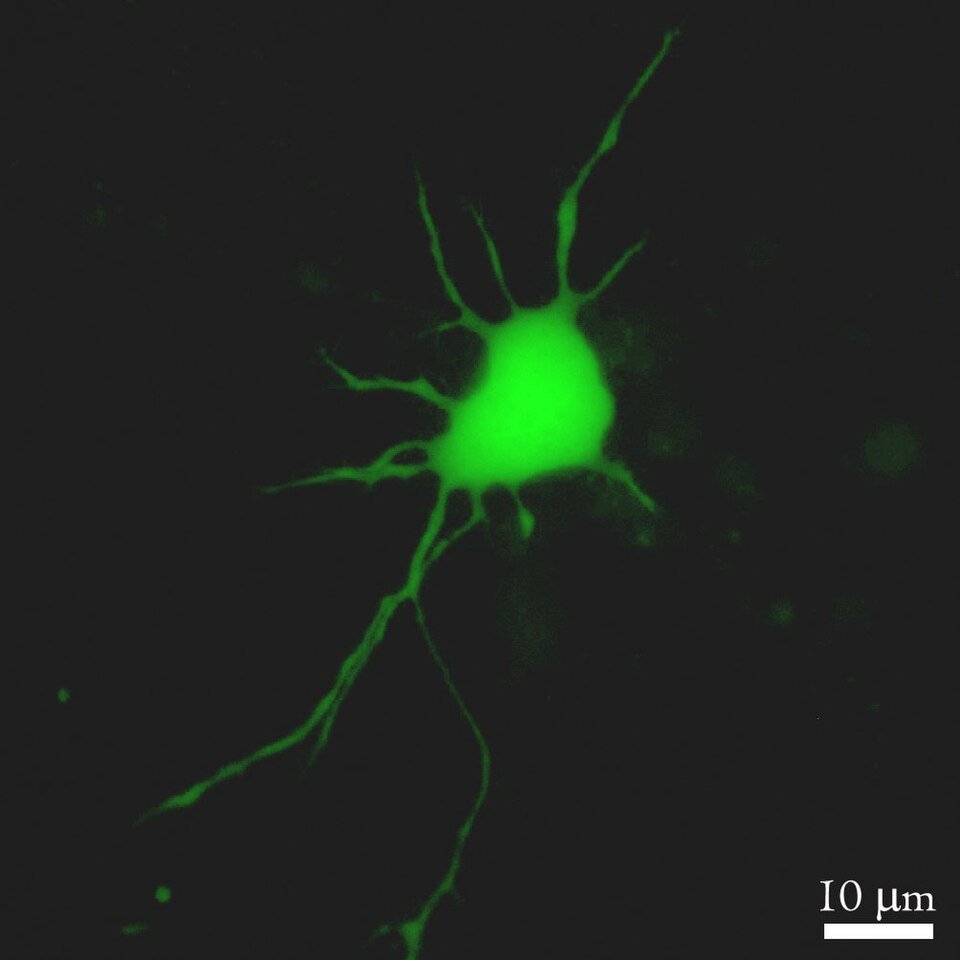
The team studied cerebellar granule neurons in developing mice, one of the most numerous neuron types in the mammalian brain. These cells are born in the external granule layer and must migrate radially through the molecular layer to the internal granule layer, navigating interstitial spaces as narrow as 3 micrometers, about a thirtieth the width of a human hair.
Using microfluidic channels with precisely controlled constrictions, the researchers showed that migration through 3-micrometer pores triggered significantly more DNA damage than migration through 8-micrometer or larger pores. Live-cell imaging of a fluorescent DNA-repair protein confirmed that transient repair foci formed precisely during nuclear deformation.
The damage is not random or accidental cell death. Key experiments showed that the migrating neurons do not rupture their nuclear membranes, unlike cancer cells forced through similar constrictions, and do not die, even when DNA repair is disabled.
How the damage happens
The culprit is an enzyme called topoisomerase IIβ (TOP2β), which normally makes controlled cuts in DNA to relieve torsional strain during transcription. Under the mechanical stress of confinement, TOP2β becomes trapped mid-cut, leaving what are known as TOP2, DNA cleavage complexes, broken DNA ends held open.
The repair pathway is non-homologous end joining (NHEJ), confirmed through inhibitor experiments: blocking LIG4 (a core NHEJ enzyme) prevented repair, while blocking homologous recombination had no effect. Conditional knockout of Lig4 in migrating neurons led to persistent double-strand breaks that lasted for months.
Strikingly, the breaks are not randomly distributed. END-seq mapping showed they are depleted from active gene promoters and enriched in heterochromatin, lamina-associated domains (2.4-fold enrichment), and LINE retrotransposons, regions where damage is less likely to disrupt essential functions.
Latent consequences
Mice with Lig4 knocked out in their cerebellar granule neurons, unable to repair the migration-induced breaks, showed a surprising picture. Despite persistent DNA damage lasting up to 12 months, there was no cell death, no microglial activation, and no neuroinflammation.
But there were behavioral changes, starting at around 3 months of age. The mice developed a progressively wider stance, shorter stride length, and hindlimb slips on balance beam tests. By 12 months, they showed a crawling gait. The phenotype is mild and late-onset, but it is real, and it shows that unresolved DNA damage from development can have tangible consequences much later in life.
Transcriptomic analysis revealed 336 differentially expressed genes, with downregulation of synaptic and developmental genes and upregulation of stress and immune pathways.
A new view of brain development
The study adds a new dimension to our understanding of brain development. “The DNA damage and subsequent repair can introduce small genetic differences between individual neurons through a small mechanical journey,” Kengaku said, a potential source of the somatic mosaicism observed in normal brains.
In a companion News & Views article in Nature, Monica Manam and Christopher Walsh of Boston Children’s Hospital and Harvard Medical School write that the findings “raise the possibility that some cases of neurodevelopmental disease linked to genome instability may be rooted in this developmental vulnerability.”
The work also resonates with recent discoveries that DNA double-strand breaks occur normally in neurons during learning and memory formation. The Kengaku team’s finding suggests that mechanical forces during development represent another source of programmed DNA damage, part of the brain’s normal construction process, but one that leaves a trace.
Caveats
The study was performed in mice, primarily in cerebellar granule neurons. Human relevance is inferred but not directly demonstrated. The behavioral phenotype in Lig4 knockout mice is mild and late-onset, not a dramatic disease model, and no direct link to a human neurodevelopmental disorder was tested. The exact biophysical mechanism by which confinement traps TOP2β remains incompletely understood.
Source: Zhang, Z., Canela, A., Kurisu, J. et al. “Confined migration induces non-lethal DNA damage in developing neurons.” Nature (2026). DOI: 10.1038/s41586-026-10648-8
See also: Manam, M.D. & Walsh, C.A. News & Views. Nature (2026). DOI: 10.1038/d41586-026-01705-3