

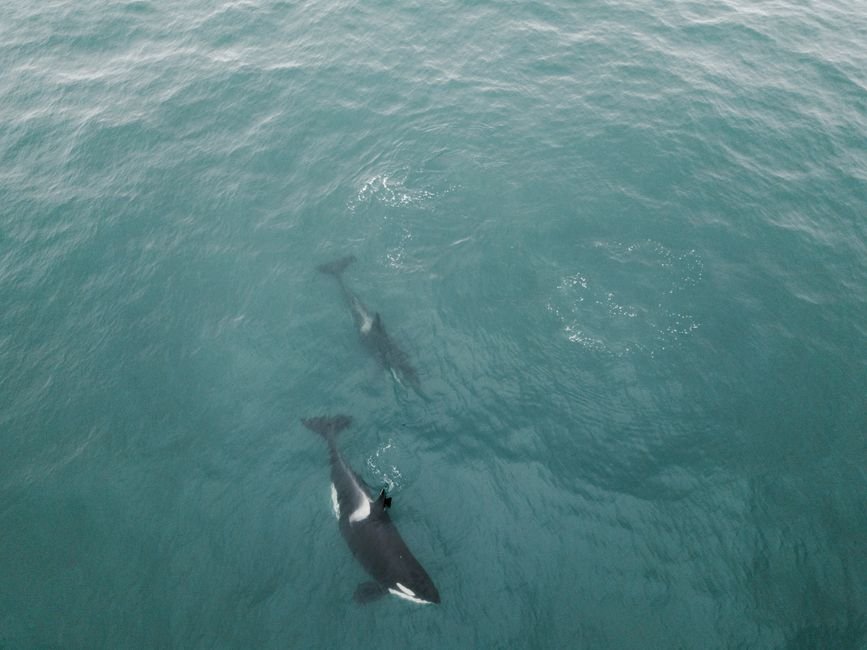
The first time Kathryn Ayres saw it through her GoPro viewfinder, she was witnessing something no scientist had ever filmed. An adult female orca held the tail end of a dead sharp-tail sunfish in her mouth, holding it steady like a sparring partner bracing a practice shield. A second orca, a large male, accelerated toward them both, swimming belly-up, and at the last instant the female released her grip. The male struck the 2,000 kg (4,400 lb) carcass at full speed. The sound traveled through the water as a percussive thud. The sunfish disintegrated into a cloud of tissue fragments. A juvenile orca, hovering nearby, began eating the pieces.
Ayres, a scientist with the nonprofit Beneath the Waves, did not need to review the footage twice to know it was new to science. The behavior, which she named “ram-to-fragment” and published July 23 in Frontiers in Ethology, is the first documented case of orcas using coordinated high-impact ramming to shatter prey into fragments. But the spectacle, gruesome as it sounds, is not the story. The story is what the technique says about how orcas learn, share, and teach.
A Two-Step Pass Play
The paper describes two separate encounters in the Gulf of California, the first filmed by researchers in July 2024 off San Jose del Cabo and the second captured by diver Hector Franz in September 2025 near Isla Cerralvo. In both cases, the sequence was strikingly similar. One adult restrained the dead sharp-tail sunfish by its clavus, the rudder-like tail appendage unique to this species. A second orca charged at high speed. The holder released the prey just before impact. The collision pulverized the sunfish’s gelatinous collagen capsule, a structure composed of roughly 90 percent water.
In the 2024 event, a juvenile orca roughly half the length of an adult female fed exclusively on the fragments that scattered through the water column. The adults ate from the remaining intact body but did not touch the pieces. In the 2025 event, a calf fed directly from the main carcass while adults manipulated the smaller fragments with their mouths. The difference may matter: it suggests the behavior is flexible, that orcas adjust who gets what depending on the age and skill of the younger animals present.
Orcas in the Gulf of California had already been documented ramming whale sharks in a 2024 paper by the same lead author, published in Frontiers in Marine Science. But those encounters involved live prey and did not include the hold-and-release choreography. The ram-to-fragment sequence is something else entirely: a coordinated two-animal maneuver in which one orca must trust the other to release on time, and the rammer must strike before the target drifts away. It demands timing, communication, and role specialization.
Play, Food, or School?
The central question, and the one that divides the experts, is whether this behavior is play or pedagogy.
Hill leans functional. “This looks like food processing and possibly teaching, not just play,” she said. “The adults are creating manageable pieces for the juveniles. The fact that the holder releases before impact, that is deliberate, coordinated precision. Play does not require that level of choreography.”
Matt Hansen, a behavioral ecologist at the Leibniz Institute for Zoo and Wildlife Research, offers a more cautious view. Ramming is not new, he notes. Orcas have been observed ramming whale sharks, sea lions, even other cetaceans. What may be novel is the hold-and-release sequence, but novelty alone does not confirm teaching. “The behavior could have emerged from food-processing efficiency and then acquired a social or play component over time,” Hansen said. “We need to see it more times and across different pods to know whether this is a learned tradition or an opportunistic one-off.”
True teaching is rare in the animal kingdom. It requires the teacher to modify its behavior in the presence of a naive observer, at some cost to itself, so that the observer learns. If adult orcas are deliberately fragmenting sunfish to create edible pieces for juveniles, forgoing those pieces themselves, that would fit the definition. If the juveniles are simply taking advantage of leftovers from a high-speed food-processing hack, the behavior is sophisticated but not instructional.
Ayres and her coauthors do not take a firm side. In the paper, they note that the ram-to-fragment behavior “may have multiple functions, including facilitating foraging for juvenile orcas or reflecting play behavior.” The ambiguity is honest, and it reflects a deeper pattern in orca research: every time scientists think they have pinned down a behavior’s purpose, the animals do something that blurs the categories.
Culture in the Water Column
What makes the ram-to-fragment observation significant beyond the debate over function is what it reveals about the broader architecture of orca social learning. Orcas are one of the few nonhuman species in which distinct cultural traditions have been documented: dialects, hunting techniques, even food preferences passed from mother to calf and across pod generations. In the North Pacific, resident orcas eat fish and vocalize in family-specific dialects. Transient orcas eat marine mammals and rarely vocalize at all. Offshore orcas eat sharks and have their own unique calls. These are not genetic differences. They are learned.
The Gulf of California orcas appear to be generalists. The same pod that rammed the sunfish in July 2024 had also preyed on a spine-tail devil ray that day. The pod filmed in September 2025 had taken a shortfin mako shark earlier in the same encounter. Generalist foraging requires a broader toolkit than specialization. Ramming a sunfish, learning the right angle of approach, the right speed, the right moment to release. These are skills that a juvenile cannot pick up by instinct alone. It must watch, practice, and fail before it succeeds.
The fact that the same basic sequence appeared in two encounters separated by 14 months suggests the behavior is being transmitted. Someone taught someone. Or someone watched and learned. Either way, the information is moving between individuals, persisting across time, and being applied to a specific prey type: the sharp-tail sunfish, whose distinct clavus makes it uniquely grabbable.
What Orcas See When They Ram
One of the more subtle observations in the paper is that the ramming orca approached belly-up in the first event and dorsal-up in the second. The researchers do not read too much into a sample size of two, but the flexibility is worth noting. Orcas are adjusting their body position in real time, calibrating impact angle to the situation. That is not a reflex. It is judgment.
There is also the question of the sound. The 2024 ramming produced a loud audible thud that the researchers could hear through the water. Orcas rely heavily on echolocation and audition. If the sound of impact carries information, how hard the hit was, whether the target shattered properly, how many pieces scattered, then the juvenile watching and listening is getting a multisensory lesson in foraging physics.
The Deeper Window
Orcas have been called the wolves of the sea, but the comparison undersells them. Wolves do not hold a carcass steady for a packmate to shatter. Wolves do not adjust their body orientation mid-charge based on the position of a floating target. And wolves, as far as anyone knows, do not fragment a 2,000 kg (4,400 lb) carcass into thousands of bite-sized pieces for their pups on purpose.
Whether the ram-to-fragment behavior is play, food processing, teaching, or all three at once, it is a window into a cognitive system that marine scientists are only beginning to map. Every new observation, the whale shark ramming in 2024, the sunfish fragmentation in 2025, adds another node to that map. Ayres put it simply in the paper’s conclusion: collecting good identification photographs of individual orcas and their techniques is essential, because “we are still seeing new techniques of how orcas hunt and process their prey.”
She is right, and the implication extends beyond orcas. If a species with a brain four times the size of a human’s can innovate, refine, and transmit a foraging technique that requires cooperative timing, role differentiation, and post-impact resource distribution, then the category of “animal culture” needs to be taken seriously, not as a metaphor, but as an operational reality measured in observed behaviors, repeated across time and space, in animals that choose to share their food and their knowledge.
Reference
Ayres KA, Gallagher AJ, Avena CV, Duarte CM, Higuera Rivas JE. Fragmentation of sharp-tail sunfish (Masturus lanceolatus) caused by high-impact ramming behavior in orcas (Orcinus orca). Frontiers in Ethology. 2026;5:1835536. DOI: 10.3389/fetho.2026.1835536