

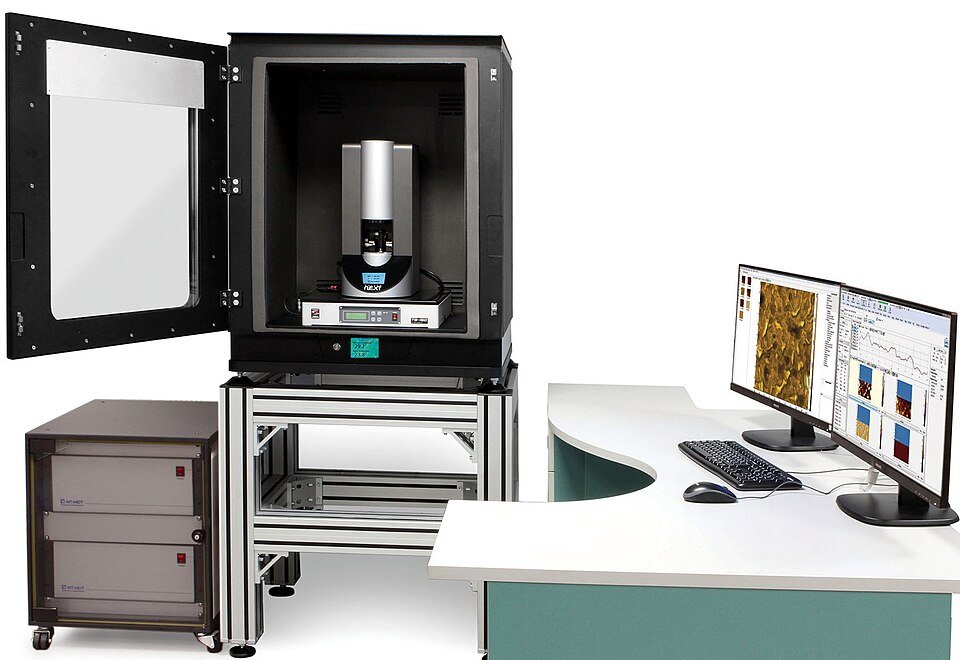
A team of physicists at the University of Maryland has developed a microscopy technique that can map both in-plane and out-of-plane optical responses at the nanoscale simultaneously, resolving features as small as 1 nanometer, roughly 25 times smaller than the probe tip itself.
The method, reported in Nature Communications, combines infrared laser excitation with torsional force microscopy (TFM), an atomic force microscope (AFM) mode that drives the cantilever at its torsional (lateral twisting) resonance rather than the conventional vertical bending mode.
“The key insight is that different harmonics of the torsional oscillation carry different directional information,” explains corresponding author Min Ouyang of the University of Maryland’s Quantum Materials Center. “Even-order harmonics tell us about in-plane responses. Odd-order harmonics tell us about out-of-plane responses.”
Conventional AFM-based infrared techniques (AFM-IR, scattering SNOM) cannot distinguish between in-plane and out-of-plane optical signals. The photothermal expansion of a sample under pulsed IR laser illumination produces both, but they are mixed together in the cantilever’s vertical deflection.
TFM-IR solves this by using nonlinear frequency mixing: the pulsed laser repetition rate is set to interact with the cantilever’s torsional harmonics. Because the torsional mode is mechanically orthogonal to the vertical bending mode used for feedback, the technique decouples sample-probe distance control from optical detection, a fundamental limitation of earlier methods.
The result is simultaneous, independent mapping of both directional components at a spatial resolution of approximately 1 nanometer full-width at half-maximum (FWHM), an order of magnitude below the tip apex radius (~25 nm), placing it in the super-resolution regime.
What they imaged
The team demonstrated the technique on three materials:
Hexagonal boron nitride (hBN): Phonon polariton imaging at 1455 cm⁻¹ revealed interference beating patterns from edge-launched and tip-launched phonon polaritons.
Birefringent muscovite mica: Anisotropic nanobubble strain mapping resolved distinct in-plane vibrational responses (Si-O-Si stretching at ~963, ~1022, ~1050 cm⁻¹) from out-of-plane modes (apical Si-O at ~995 cm⁻¹). These directional signatures agreed quantitatively with COMSOL finite-element simulations.
Twisted bilayer graphene (tBLG): The most striking demonstration, imaging the moiré superlattice with 6.1 nm periodicity (~2.4° twist angle). The team performed site-resolved spectroscopy at 15 positions within a single moiré unit cell and identified three distinct amplitude clusters corresponding to local AA vs. AB/BA stacking configurations. Energy-dependent imaging at 5 wavenumbers (1546,1597 cm⁻¹) revealed two types of optical motifs within the moiré cells: dot-like hotspots with two-fold symmetry and triangular patch features with three-fold symmetry, patterns that break the six-fold rotational symmetry of the underlying lattice.
The persistent challenge
Direction-resolved nanoscale optical imaging has been a long-standing goal in near-field optics. Previous techniques could either achieve high resolution or separate directional components, not both.
“The ability to cleanly separate in-plane and out-of-plane responses at the single-unit-cell level opens up new possibilities,” says Yonatan Gazit, the study’s first author. “Understanding how light interacts with materials at this scale is critical for designing next-generation optoelectronic devices.”
A crosstalk correction matrix (R_in = 0.814, R_out = 0.538) was developed to separate the channels cleanly.
Caveats
The technique requires specialized AFM hardware capable of mechanically driving torsional resonances (typically 1,3 MHz) and integrating pulsed IR lasers with frequency-mixing electronics, not a simple retrofit for standard instruments. It has been demonstrated only on select 2D materials and crystalline samples; generalizability to soft matter, biological tissues, or polymers has not yet been shown. The paper is an early-access manuscript and may differ from the final published version.
What’s next
The team plans to explore applications in semiconducting quantum materials, heterostructures, and polymers, and to investigate whether the technique can be extended to sub-millisecond temporal resolution for studying dynamic processes at the nanoscale.
Source
Gazit Y, Le ST, Hanbicki AT, Friedman AL, Ouyang M. “Direction-resolved nanoscale optical imaging with near-nanometer resolution by emerging infrared torsional force microscopy.” Nature Communications (2026). DOI: 10.1038/s41467-026-74654-0
Funding: U.S. Department of Defense; U.S. Department of Energy Office of Basic Sciences (DESC0010833).