

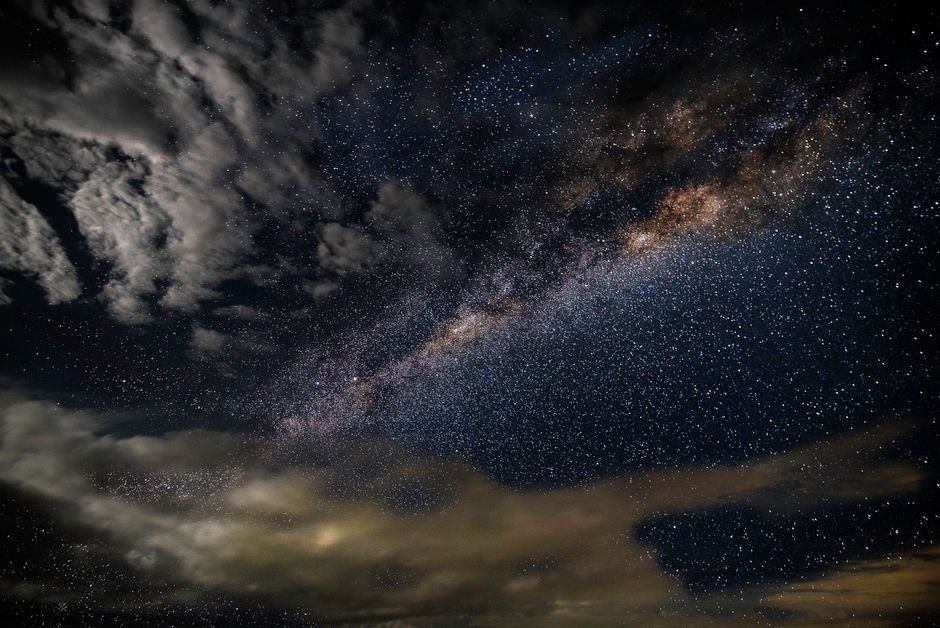
The stars that make up the Milky Way’s halo, a diffuse spherical cloud surrounding the galaxy’s disk, move at a puzzlingly slow speed. At about 25 kilometers per second relative to the galactic center, they crawl compared to the Sun’s 220-kilometer-per-second orbit. Standard models of galaxy formation predicted the halo should rotate at 50 to 60 kilometers per second. The discrepancy has been a quiet embarrassment in astronomy for years; the numbers simply did not match.
A team at Durham University has now offered an explanation, and it involves one of the most violent events in the Milky Way’s history.
A clue hidden in the halo’s rotation
Kirill Batrakov and his colleagues ran the Auriga suite of cosmological simulations, which model the evolution of 25 Milky Way-like galaxies from the early universe to the present day. Each simulation tracks millions of particles representing stars, gas, and dark matter over billions of years. The team was looking for the factors that determine how fast a galaxy’s stellar halo rotates.
They found two. The first was the presence of substructures left over from the Gaia-Enceladus-Sausage merger, a known collision between the Milky Way and a dwarf galaxy that occurred roughly 10 billion years ago. The second was something unexpected: a disk flip.
When a dwarf galaxy hits a larger galaxy face-on, the impact can transfer angular momentum in ways that cause the larger galaxy’s disk to rotate by 90 degrees or more. The Milky Way, the simulations suggest, experienced exactly this kind of flip. The stellar halo inherited the slow rotation of the pre-impact disk, and it has preserved that signature for 10 billion years.
A 90-degree tumble over a billion years
The flip was not instantaneous. The simulations show it took between 150 million and just over 1 billion years to complete, a slow, stately rotation driven by the gravitational aftermath of the collision. The Sun and the solar system did not yet exist; they formed roughly 5 billion years ago, well after the event was over.
The Gaia-Enceladus-Sausage dwarf galaxy, whose debris forms a distinctive sausage-shaped distribution in the Milky Way’s halo, was the likely culprit. It struck the young Milky Way head-on, a direct hit that transferred so much angular momentum that the galaxy’s disk tilted by more than 90 degrees relative to its original orientation.
Batrakov presented the findings at the Royal Astronomical Society’s National Astronomy Meeting in Birmingham. The work links two seemingly separate features of the Milky Way, the slow halo rotation and the peculiar distribution of merger debris, and traces both to the same ancient collision.