

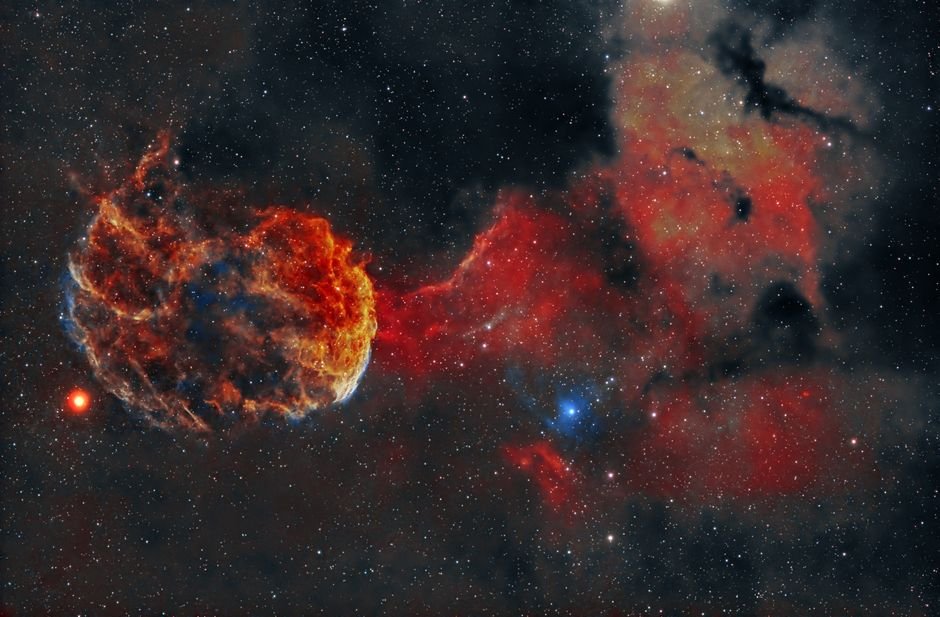
Most massive stars in the universe are born in pairs or triples. They orbit each other, exchange material, and eventually explode. Logically, binary supernovae should be common. And yet, until now, no one had ever found a pair of sibling stars that both detonated as supernovae.
The reason is simple: the first explosion is so bright that it masks everything around it. Its expanding debris shell dominates the sky in that region for thousands of years. Finding a second, fainter remnant next to it requires instruments sensitive enough to detect what the glare hides.
A team led by Miltiadis Michailidis at Stanford University has now found one, using 16 years of data from the Fermi Gamma-ray Space Telescope. The discovery, published in Nature Communications, resolves a puzzle that has bothered astronomers since the first binary star models were developed.
Two explosions in the same stellar nursery
The target was IC 443, known as the Jellyfish Nebula, a well-studied supernova remnant about 5,000 light-years away. Next to it, earlier X-ray observations from eROSITA had detected a fainter shell of plasma heated to over 8 million degrees Celsius. Designated G189.6+3.3, this second shell had the thermal signature of a supernova remnant but lacked the radio signal needed for confirmation.
Michailidis and his team analyzed Fermi’s gamma-ray dataset, searching for high-energy emission that would confirm a second explosion. They found a complex gamma-ray glow tracing the X-ray shell, but with a twist: the northern part of the shell emitted gamma rays from accelerated protons interacting with a dense hydrogen cloud, while the rest emitted gamma rays from accelerated electrons. This dual mechanism matched the known interaction of the Jellyfish Nebula with the same hydrogen region, confirming the two remnants were physical neighbors, not a coincidence of projection.
Computer simulations reconstructed the likely sequence. Two massive stars orbited each other. The first exploded, kicking the surviving star away. The second traveled far enough that when it detonated, its debris did not merge with the first remnant. The two explosions occurred within thousands to tens of thousands of years of each other, an eyeblink in cosmic terms.
A new window into stellar violence
The discovery gives astronomers something they have never had: a direct measurement of the timing and distance between two supernovae from the same binary system. This allows the first empirical calculations of how supernova energy propagates through the surrounding medium, rather than relying solely on theoretical models.
Mikako Matsuura of Cardiff University, who was not involved in the study, called the timing of the two events “a reasonably short astronomical time scale”, close enough that the same gas cloud was still present when both stars exploded.
The team plans to search for more binary supernova remnants, using the same gamma-ray technique to peel back the glare of known supernovae and look for hidden partners.