

In August 2025, the Goldstone Deep Space Complex in California pointed its 70-meter antenna at a near-Earth object called 1998 SH2. The radar saw nothing. The asteroid, estimated at 380 meters across, should have been easy to detect. The fact that Goldstone’s DSS-14 – the most powerful planetary radar antenna in the world – drew a blank was the first clue that something was wrong.
A Brazilian observatory, SONEAR, located the object on August 31. It was 190 kilometers from where the calculations said it should be. For an object whose orbit is determined by well-understood gravitational physics, an error of 153 arcseconds is not a small discrepancy. It is a sign that something other than gravity is pushing the rock around.
The hunt for a hidden force
Davide Farnocchia of NASA’s Jet Propulsion Laboratory led a team to investigate. They calculated the non-gravitational acceleration acting on 1998 SH2 and found it was ten times larger than the maximum possible from the Yarkovsky effect – a well-known phenomenon where an asteroid absorbs sunlight and re-emits it as heat, producing a tiny thrust. Ten times the Yarkovsky maximum left only one explanation: outgassing.
This was surprising because 1998 SH2 had been classified as an asteroid for nearly three decades. It showed no cometary tail, no visible atmosphere, none of the usual signs of volatile material boiling off a nucleus. Objects like this have a name: dark comets. They look like asteroids but shed material like comets, and they are frustratingly hard to identify.
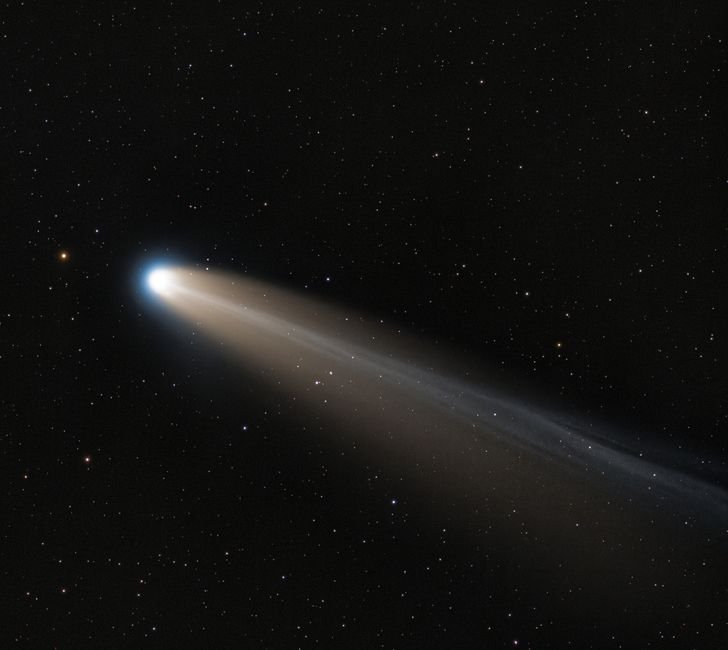
The team turned to the Canada-France-Hawaii Telescope and the Very Large Telescope in Chile. By stacking long-exposure images, they resolved a faint cometary tail about 20 arcseconds long – barely visible, but unmistakable. The tail was composed of dust grains roughly 400 micrometers across, released between August 29 and September 7, 2025. The activity peaked several weeks after the object passed closest to the Sun, suggesting the ice that powered it was buried deep inside the body. The object has been reclassified as comet P/1998 SH2.
Why this matters for planetary defense
The discovery, published in Nature Astronomy, has implications beyond classification debates. Of the roughly 285 near-Earth objects currently classified as potentially hazardous asteroids, an unknown fraction may be dark comets – objects whose orbits can shift unpredictably due to outgassing.
Non-gravitational acceleration from sublimating ice is chaotic. It depends on how much ice is present, how deep it is buried, and how the object rotates. Unlike the Yarkovsky effect, which follows predictable physics, outgassing can change the orbit of an object in ways that are difficult to model without detailed interior data.
Farnocchia’s team argues that continuous, precise tracking of all potentially hazardous objects is necessary to catch unexpected accelerations early. A rock that is quietly degassing and slowly drifting off its predicted path looks, from the ground, like an object that has suddenly changed course.
Clark – 1ban.news