

A good night’s sleep is surprisingly hard to study. The gold standard, polysomnography, requires a patient to spend a night in a lab with electrodes glued to the scalp, face, chest, and legs, plus belts around the torso and a pulse oximeter on the finger. The setup is expensive, uncomfortable, and impractical for the kind of regular monitoring that sleep disorders actually need.
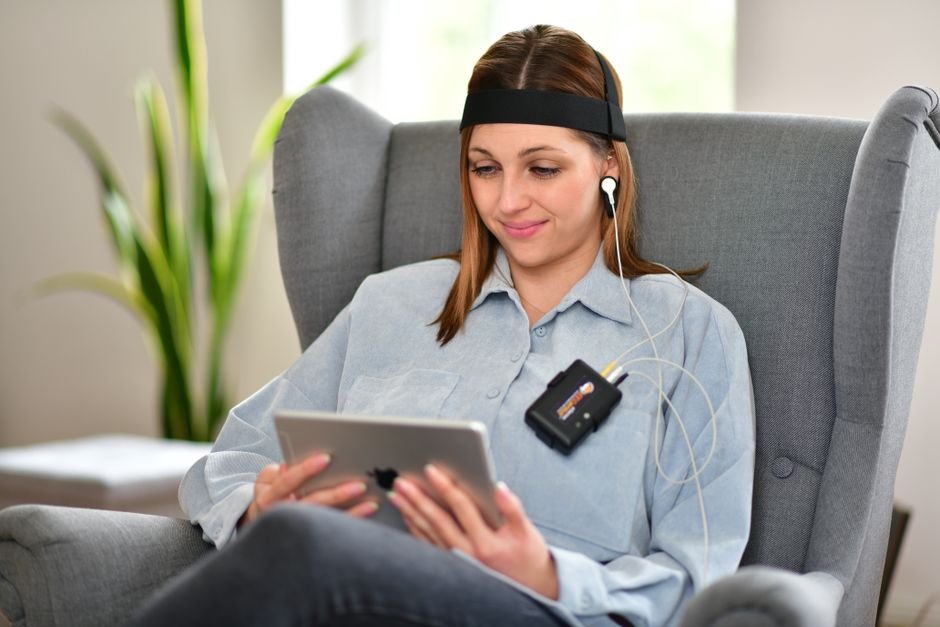
Researchers have been chasing a simpler alternative for years: a single channel of EEG, recorded from a few electrodes on the forehead or behind the ear, paired with an algorithm that can figure out sleep stages on its own. The challenge is that a single channel captures far less information than the full clinical montage, and the brain’s electrical patterns during sleep are subtle and easily confused.
A team from Tarbiat Modares University in Tehran and Michigan State University has now published a method that pushes single-channel sleep staging closer to clinical usefulness. Their approach, described in Scientific Reports, combines a specialized time-frequency transformation called the SynchroSqueezed Transform with a three-stage deep learning pipeline to reach 83 percent overall accuracy on a standard benchmark dataset.
From raw waves to sharp pictures
The first problem any single-channel sleep staging method faces is how to represent the raw EEG signal. A 30-second recording is a noisy wiggle of voltage changes over time. The meaningful information for sleep staging lies in which frequencies are present and how their power shifts across the night — the slow delta waves of deep sleep, the sleep spindles of stage 2, the fast alpha and beta rhythms of wakefulness.
The standard way to extract this information is a spectrogram, which chops the signal into short windows and computes the frequencies present in each one. But spectrograms have a fundamental tradeoff: better time resolution means worse frequency resolution, and vice versa. The SynchroSqueezed Transform used by Aram and colleagues sidesteps this limitation by reassigning spectral energy to sharper, more concentrated ridges in the time-frequency plane. The result is a much cleaner picture of how the brain’s rhythms evolve over time, with less blurring between nearby frequencies.
The team divided each 30-second epoch into 256-sample segments — roughly 2.56 seconds at the 100 Hz sampling rate of the Sleep-EDF dataset they used. They fed these short segments into a convolutional neural network in the first stage of what they call a sequential representation learning pipeline.
Learning to see the difference
Training a deep neural network from scratch on a task as complex as sleep staging is difficult, especially with the limited data from a single EEG channel. The researchers addressed this with a three-stage strategy that resembles how a specialist might learn: first understand the basics of EEG patterns, then learn to distinguish between sleep stages, and finally learn how stages follow each other in time.
Stage one is straightforward supervised pretraining. The CNN learns to classify the 2.56-second micro-segments into sleep stages, building a foundation of useful feature extractors. But the team’s key innovation comes in stage two: contrastive learning.
Contrastive learning works by teaching the network to pull representations of similar signals closer together while pushing representations of different signals apart. The researchers applied this at the epoch level — the full 30-second window — by creating positive pairs from the same sleep stage and negative pairs from different stages. This step sharpens the encoder’s ability to separate sleep stages in the abstract space where the network represents EEG signals, even before it sees the temporal structure of a full night.
Stage three is where the network learns to think in sequences. The pretrained encoder processes the full 3000-sample epoch using a time-distributed strategy, meaning it slides across the signal in chunks and produces a sequence of feature vectors. These vectors are fed into two stacked Gated Recurrent Units — a type of recurrent neural network specialized for learning patterns that unfold over time. The GRUs capture the dependency between consecutive epochs: the fact that stage 2 sleep usually precedes slow-wave sleep, that REM follows a specific progression through the cycle, that waking up in the middle of stage 3 is unlikely.
83 percent and what it means
The method achieved 83 percent overall accuracy on the Sleep-EDF dataset, a widely used collection of overnight EEG recordings from healthy subjects. Performance varied by sleep stage. Wakefulness and REM sleep were classified most accurately. The deeper stages of non-REM sleep — stage 3, sometimes called slow-wave or delta sleep — showed higher confusion, as they often do in automated sleep staging.
Eighty-three percent is not perfect, and it would not replace a clinical polysomnogram for diagnosing complex sleep disorders. But it is competitive with the state of the art for single-channel methods, and it comes from a pipeline that combines existing techniques in a novel way. The use of contrastive learning to improve feature separability before sequence modeling is a distinction from earlier approaches that train the whole network end to end.
From lab to bedroom
A single EEG channel can be recorded with a minimal setup — an adhesive patch behind the ear, a headband, a small wearable. No technician required, no overnight stay. For patients with suspected sleep apnea, the initial screening could happen at home over multiple nights, producing a more representative picture than a single night in an unfamiliar lab. Automating the manual scoring that sleep specialists currently perform could also free up clinical resources in settings where trained scorers are scarce.
What it cannot do yet
The Sleep-EDF dataset, while standard, contains recordings from only a modest number of healthy subjects with no major sleep disorders. Whether the method generalizes to patients with conditions like insomnia or narcolepsy is unknown. The algorithm also relies exclusively on EEG, missing the muscle tone and eye movement channels that polysomnography uses to distinguish REM from wakefulness. Adding those signals would likely improve accuracy but would also increase setup complexity. The method has not been tested on low-cost consumer EEG hardware or in uncontrolled home environments, either.
The bottom line
Automated sleep staging from a single channel has been a target for years. The combination of SynchroSqueezed Transform preprocessing with contrastively pretrained recurrent networks represents a genuine methodological advance, even if 83 percent accuracy leaves room for improvement. The approach brings the field another step closer to the goal of reliable, comfortable, at-home sleep monitoring that works without a sleep lab.
Source: Aram, S., Ghassemi, M.M. & Mohammadzadeh Asl, B. Single-channel EEG sleep stage classification using synchrosqueezed transform and sequential representation learning. Sci Rep 16, 42477395 (2026). https://doi.org/10.1038/s41598-026-62832-5