

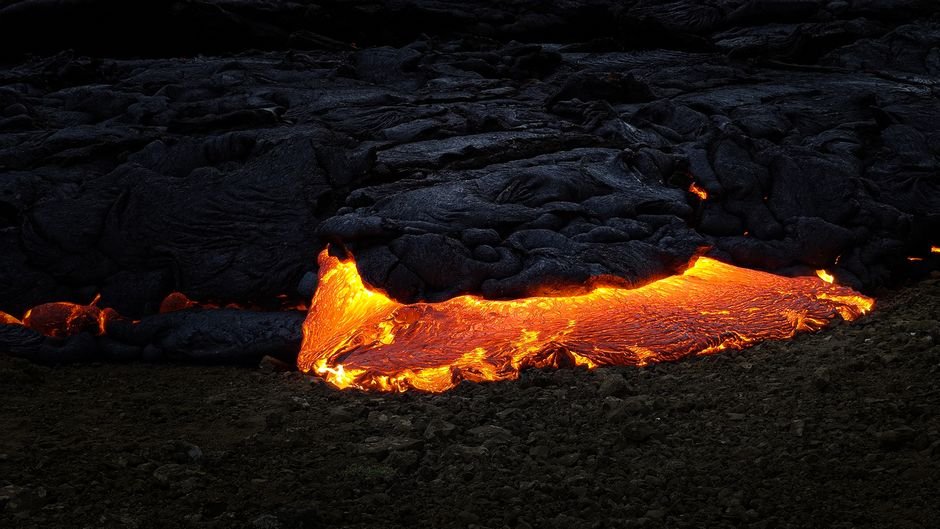
A cooler Earth core solves a magnetic mystery
Earth’s core may be about 1,000 degrees Celsius cooler than scientists have long believed, according to a new technique for measuring the temperature of molten iron under extreme pressures. The findings, presented July 17 at the Goldschmidt Conference in Montreal, do more than revise a number, they may resolve a puzzle that has troubled geophysicists for years: how Earth’s magnetic field survived for billions of years before the solid inner core formed.
A temperature that has been hard to pin down
The inner core boundary, about 5,150 kilometers below the surface, is where liquid iron alloy in the outer core freezes onto the solid inner core. Its temperature is not measured directly, no drill has ever come close, but inferred from laboratory experiments that recreate the crushing pressures of the deep Earth.
The standard estimate has hovered around 6,000 K (about 5,700 degrees Celsius), roughly the temperature of the Sun’s visible surface. That figure came from a combination of diamond-anvil cell experiments and theoretical models, most notably a 2013 study in Science that reported an iron melting temperature of about 6,230 K at inner-core boundary pressures using fast X-ray diffraction.
The new work, still awaiting peer-reviewed publication, introduces a method the researchers say gives a more direct measurement of molten iron’s temperature at extreme pressure. The technique, pulsed Joule heating combined with in-situ temperature measurement, heats metal samples to temperatures exceeding 4,000 K at pressures above 200 gigapascals, or about 2 million atmospheres. The researchers found that iron’s melting temperature at inner-core boundary conditions is closer to 5,200 K, roughly 1,000 degrees cooler than the previous benchmark.
Why the magnetic field cares about the temperature
The temperature at the inner-core boundary matters for more than planetary trivia. It determines when the inner core first began to freeze, an event that fundamentally changed how Earth’s magnetic field operates.
Earth’s magnetic field is generated by convection in the liquid outer core, where molten iron rises, cools, and sinks in a self-sustaining dynamo. When the inner core began to solidify, it released latent heat and light elements into the outer core, providing an additional buoyancy source that strengthened and stabilized the field.
The problem is that a hot core, at 6,000 K, would have taken a long time to cool enough for the inner core to start freezing. Some models suggested the inner core might be only about 1 billion years old, yet paleomagnetic evidence shows that Earth has had a magnetic field for at least 3.5 billion years, and possibly longer. That left a 2.5-billion-year gap where the field had to be powered without the help of the inner core, a puzzle known as the “new inner core problem.”
A cooler core solves it. If the inner core boundary is at 5,200 K rather than 6,000 K, the inner core would have begun freezing much earlier in Earth’s history, potentially 2 to 3 billion years ago. The magnetic field would have had a solid inner core, and its stabilizing energy boost, for most of the planet’s history, not just its most recent quarter.
Implications for planetary evolution
The finding also has implications beyond Earth. The temperature of a planet’s core governs how long its magnetic field can persist, which in turn determines whether its atmosphere survives against erosion by the solar wind. Mars, which lacks a global magnetic field, lost most of its atmosphere billions of years ago. Venus, which may never have developed a solid inner core, has no internally generated field.
If Earth’s core is cooler than thought, it may also be cooling faster. Geochemists have long debated how much radioactive heat remains in the core, a key unknown in thermal evolution models. A lower starting temperature tightens the constraints on the core’s energy budget and may help settle whether the geodynamo is slowing down.
The research was presented at the Goldschmidt Conference, the annual international geochemistry meeting, by a team whose technique uses pulsed electrical heating to reach core-like conditions in the lab. A preprint or peer-reviewed publication is expected to follow.
Main source: Science.org reporting from Goldschmidt Conference, Montreal, July 17, 2026.