

Editor’s note: This is an opinion article. The following reflects the author’s assessment of events that threaten the integrity of the scientific enterprise.
In late May, the White House Office of Management and Budget published a 411-page proposal that would fundamentally restructure how federal research dollars are spent in the United States. On its face, it is a rule change, a revision to the Uniform Guidance for Federal Financial Assistance. In practice, it would hand control of nearly every American research grant to political appointees, replace peer review with partisan loyalty tests, and ban international scientific collaboration.
Colette Delawalla, the 32-year-old founder of Stand Up for Science, put it bluntly: “The purpose of the rule is fascism.”
She is right. And we should not pretend otherwise.
The proposed Regulation for Federal Financial Assistance (RFFA) would:
- Place all discretionary federal grants under the control of political appointees, replacing the peer-review system, the decades-old, merit-based process in which scientists evaluate each other’s proposals, with a requirement that awards “demonstrably advance the president’s policy priorities”
- Allow agencies to terminate any grant at any time for any reason
- Prohibit funding for research deemed to “promote anti-American values”
- Ban all federally funded international scientific collaborations with China, Russia, Iran, North Korea, and Saudi Arabia, extending the existing Wolf Amendment (which currently restricts NASA from working with China) to every science agency
- Ban funding related to DEI initiatives, gender identity, and transition care for minors
Stand Up for Science’s analysis of the rule found that nearly 5,000 active NIH-funded clinical trials, including over 1,000 cancer trials, could be shut down on day one.
This is not a marginal adjustment. This is a dismantling operation.
The real target
The rule’s defenders, OMB Director Russ Vought among them, frame it as a corrective to a system that has “promoted a far-left agenda.” An OMB spokesman told the Guardian: “Federal grants were already politicized to promote a far-left agenda. That ends now.”
This is a perversion of the truth. The peer-review system is not perfect, it can be slow, conservative, and prone to groupthink. But it is fundamentally meritocratic. Research is funded based on the judgment of scientific peers who evaluate methodology, feasibility, and significance. That is not a political process. It is the closest thing science has to a fair trial.
What the RFFA proposes instead is a system in which a political appointee, someone whose qualifications have nothing to do with molecular biology, oceanography, or clinical trial design, can veto a grant because it does not align with the president’s priorities.
As Elizabeth Ginexi, a former NIH senior program officer of 22 years, put it: “Who should be making that decision, other scientists, oncologists, or do you want Russell Vought and Donald Trump making that decision?”
The answer is obvious. Yet the administration is pushing forward.
The damage is already visible
The RFFA is not the first attack on science in this administration. It is the culmination of a year-long campaign.
- Nature documented that 7,800+ NIH and NSF grants were terminated or frozen in 2025 alone
- 25,000+ scientists and personnel have left federal agencies
- 10,000+ postdoctoral experts have departed from the federal workforce
- The National Science Board, the NSF’s entire advisory body, was fired, all 22 members
- The Ocean Observatories Initiative, a $386M network of 900+ ocean sensors, is being partially dismantled, a buoy was pulled on June 16
- NOAA faces proposed cuts of $2.2 billion, including the dissolution of the Office of Oceanic and Atmospheric Research and elimination of the 50-year-old Sea Grant program
The RFFA would make permanent what has so far been reversible. It would codify political control over science into federal regulation, making it far harder for a future administration to restore the system.
As climate scientist Kate Marvel, formerly of NASA, said: “The proposal to base funding decisions on alignment with the administration’s agenda is a particularly acute threat for climate and weather funding, which protects our nation’s infrastructure, economy, agriculture, public safety, and national security.”
This is not a both-sides story
There is a temptation in science journalism to treat every controversy as having two valid perspectives. This is not one of them.
The peer-review system is the foundation of modern science. It is what made the United States the world’s dominant research power. Replacing it with political control is not a legitimate policy alternative, it is an act of sabotage.
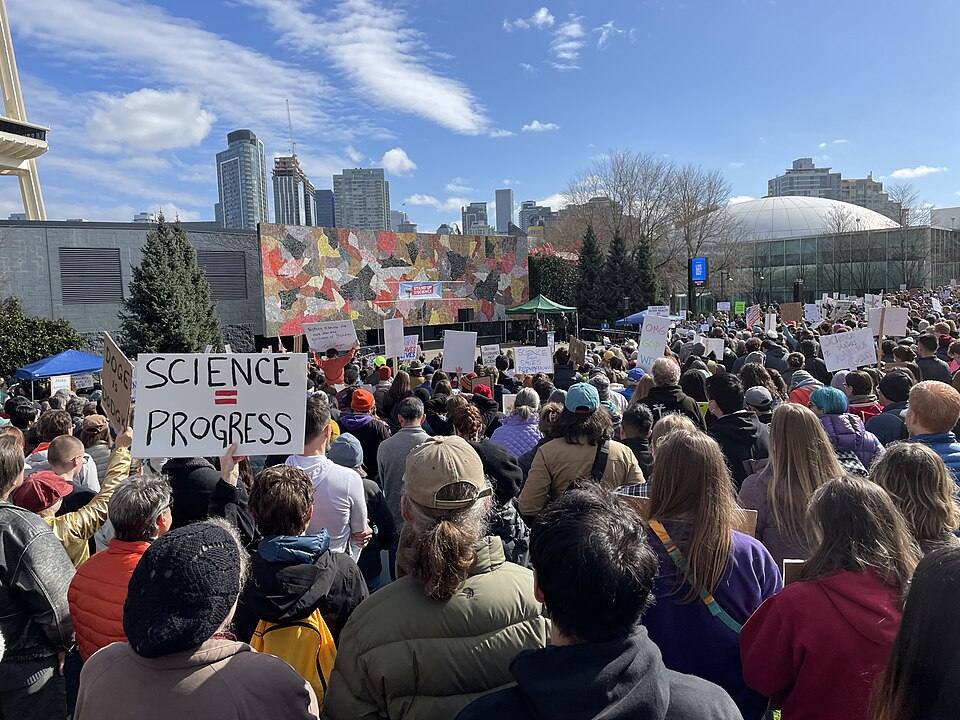
Stand Up for Science has mobilized over 50,000 people, collected nearly 31,000 public comments on the rule, assembled a network of 50 attorneys to prepare legal challenges, and brought 30 members of Congress to the table. They have requested a 60-day extension of the public comment period (deadline: July 13). They deserve support.
As Delawalla said: “We’re advocating for democracy. If you tell people in a country they’re not allowed to study certain things with federal money, you’re not in a free country.”
Science is not a partisan enterprise. But defending it has become one. And on this question, there is no middle ground.
Source
Based on reporting from The Guardian (June 19, 2026), Nature (June 3, 2026), CNN (June 4, 2026), and Stand Up for Science press materials. Public comment on the proposed RFFA rule is open through July 13, 2026, at regulations.gov.