

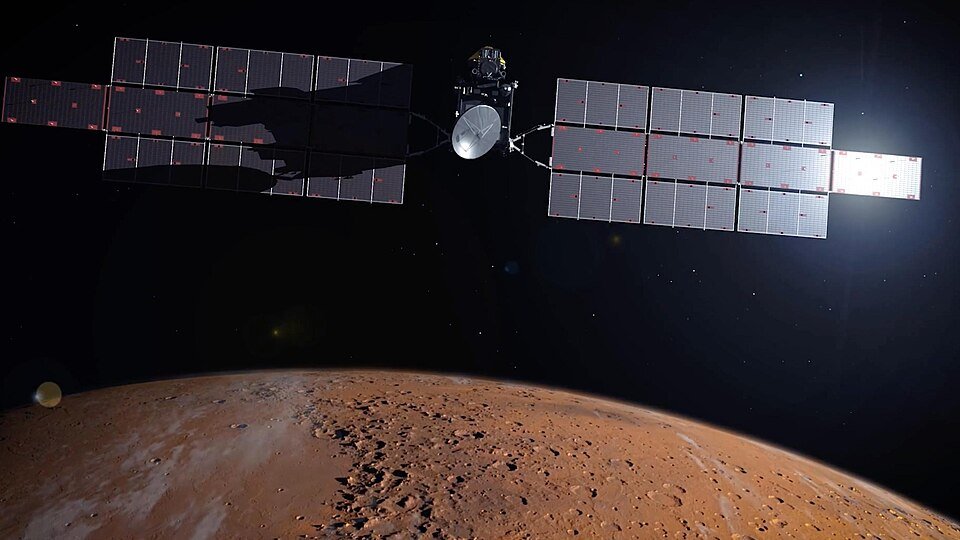
The Aeolus orbiter will carry four NASA-built scientific instruments to Mars to study the planet’s atmosphere in unprecedented detail. The instruments include a Doppler Wind and Temperature Sounder (DWTS-Ozone) to measure wind and temperature profiles, a Thermal Limb Sounder (TLS) for vertical temperature and dust measurements, a Surface Radiometric Sensor Package (SuRSeP), and a Wide-Field Context Camera (WFCC) for daily global imaging of atmospheric activity.
NASA says the instrument suite will provide “the first integrated, daily, global view of Martian winds, temperatures, dust and clouds,” data that the agency considers essential for reducing landing risks for both robotic and future crewed missions to the Red Planet.
“Public-private partnerships like this are a force multiplier for science,” NASA Administrator Jared Isaacman said at a June 17 announcement event at Relativity Space’s facilities. “By pairing NASA’s world-class instruments with commercial innovation and investment, we can deliver more science, more often, and reduce the time it takes to get essential data into the hands of researchers preparing for future human missions to Mars.”
Relativity’s long road to Mars
Relativity Space was founded in 2015 by former SpaceX and Blue Origin engineers with a vision of using large-scale 3D printing to build cheaper rockets. The company’s first vehicle, the small-lift Terran 1, flew a single test flight in March 2023 that failed to reach orbit before the company pivoted to the much larger Terran R, a two-stage reusable rocket designed to compete with SpaceX’s Falcon 9 and Falcon Heavy.
Before the company could get Terran R to the launch pad, it ran into fundraising difficulties in a challenging capital environment for launch startups. Eric Schmidt, the former Google executive chair and longtime Silicon Valley power broker, acquired a controlling interest in Relativity Space in March 2025 and installed himself as CEO, a move that raised eyebrows in an industry where rocket development has a notoriously low success rate.
Under Schmidt’s leadership, the company has pursued a broader vision that extends beyond launch services. Schmidt has publicly discussed ambitions to place data centers in orbit and has also funded a space telescope project called Lazuli through his philanthropic organization, Schmidt Sciences.
The MAVEN gap
The Aeolus mission takes on added urgency following NASA’s recent loss of contact with the Mars Atmosphere and Volatile Evolution (MAVEN) spacecraft, which had been studying the Martian atmosphere since 2013. After developing rotation problems in December 2025, MAVEN went silent, removing a critical node from the joint NASA-ESA Mars Relay Network that enables communication with surface probes.
Aeolus is designed to fill this gap, providing not only atmospheric science data but also demonstrating the commercial sector’s ability to deliver planetary science missions on a timeline and budget that traditional government-led programs struggle to match.
The SpaceX factor
The contract sets up an intriguing competitive dynamic with SpaceX. Elon Musk has long spoken of Mars colonization ambitions, but SpaceX has never flown a dedicated science mission to the Red Planet. (The 2018 Tesla Roadster launched on Falcon Heavy’s maiden flight was a test payload that overshot Mars.) If Relativity’s Aeolus reaches Mars on schedule, it could become the first privately developed spacecraft to orbit another planet.
Under the partnership structure, NASA provides the instruments and scientific guidance while Relativity Space provides the spacecraft, launch vehicle, and cruise operations. The financial terms of the contract have not been disclosed. The science instruments are supported for at least one Mars year (approximately 1.88 Earth years) of operations.
Unanswered questions
The mission faces significant technical hurdles. Relativity Space has not yet reached orbit with Terran R, whose debut flight is expected later in 2026. The company must simultaneously complete the rocket, design and build the Aeolus spacecraft, and hit a narrow 2028 interplanetary launch window. NASA’s track record with startup partners has been mixed, with some failing to deliver on time and one commercial lunar lander tipping over on arrival.
Nonetheless, the agency is betting that lower costs and faster timelines justify the risk. If successful, Aeolus would validate a model in which the commercial sector handles interplanetary transportation while NASA focuses on the science. The strategy, already proven for International Space Station cargo and crew missions, would extend to the kind of deep-space exploration that has traditionally been the exclusive domain of government agencies.
*