

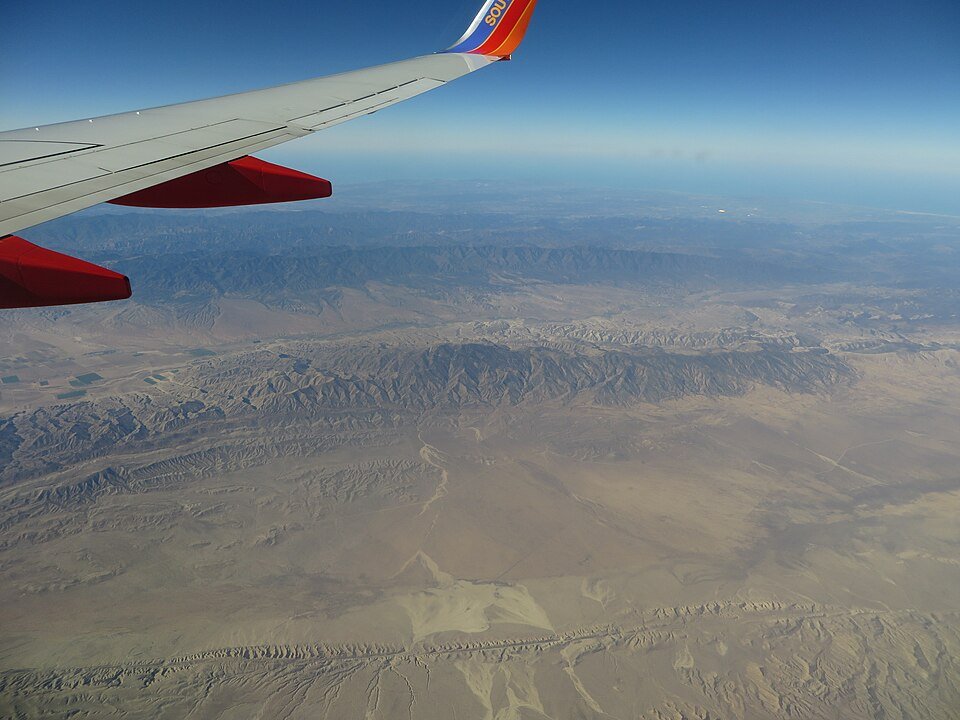
Deep beneath Cajon Pass, a mountain corridor 63 miles northeast of Los Angeles where the San Andreas Fault and the San Jacinto Fault intersect, the crust is under more stress than at any point in the last 1,000 years. A new physics-based earthquake cycle model, published June 3 in the Journal of Geophysical Research: Solid Earth, shows that both fault systems are now carrying stress levels that, historically, have preceded some of the largest earthquakes in Southern California.
The study, led by Dr. Liliane M. L. Burkhard of the University of Hawai’i at Manoa and the University of Bern, along with Bridget Smith-Konter, Katherine Scharer of the U.S. Geological Survey, and David Sandwell of Scripps Institution of Oceanography, reconstructs 1,000 years of earthquake history on 38 fault segments from the Carrizo Plain to Borrego Mountain. The model tracks stress changes from every known earthquake, stress accumulation during quiet intervals, and the slow relaxation of the deep crust after large ruptures.
The result is a detailed portrait of a landscape bearing an unusually heavy load.
The researchers identify Cajon Pass as what they call an “earthquake gate”, a structural junction whose behavior depends on the stress balance between the two fault systems. When the stress on both sides is similar, a disparity of less than approximately 0.2 megapascals, a rupture on one fault can propagate across the pass to the other, producing a larger, multi-fault earthquake. When the stress differs significantly, the rupture stops at the gate.
This gate has operated in both modes in recorded history. In 1812, the Wrightwood earthquake involved a joint rupture of the San Andreas and San Jacinto faults, a gate-open event. In 1857, the Fort Tejon earthquake (magnitude 7.9) ruptured the San Andreas but terminated at Cajon Pass and did not involve the San Jacinto, a gate-closed event.
The current situation is distinctly concerning because both sides are at historically matched high stress. The San Jacinto-Bernardino segment has reached 3.6 megapascals, 24 percent above its previous maximum of 2.9 megapascals recorded in 1249. The Mojave South segment of the San Andreas has reached 2.8 megapascals, at or above any value in the last millennium.
How the model works
The simulation, based on a semi-analytic Fourier transform model called “maxwell” originally developed by Sandwell and Smith-Konter, models the Earth’s crust as a 60-kilometer-thick elastic plate overlying a viscoelastic half-space. The input is a painstakingly reconstructed earthquake record spanning the years 800 to 2025, assembled from radiocarbon dating of displaced sediments, tree-ring anomalies, historical documentation of ground ruptures, and paleoseismic data.
The model tracks three processes simultaneously: the sudden stress drop during each earthquake, the slow stress accumulation during quiet intervals as tectonic plates continue to move, and the viscoelastic relaxation of the deep crust after large ruptures, which can transfer stress to neighboring fault segments over years to decades.
Stress accumulation rates vary across the region. The Mojave South segment accumulates stress at 1.8 megapascals per century, the San Jacinto-Bernardino at 1.4, and the North San Bernardino segment of the San Andreas at 1.0. To put 3.6 megapascals in perspective: it is equivalent to the pressure at about 360 meters below the ocean surface.
A 168-year quiet period
The last major rupture in the region was the 1857 Fort Tejon earthquake, 168 years ago. This is the longest quiet period in the simulation since at least the year 800. Stress that would normally have been released by large earthquakes has instead been accumulating continuously.
“Both the San Andreas and San Jacinto faults are now at or above their maximum stress levels from the last 1,000 years,” the researchers write. The stress on the San Jacinto-Bernardino segment already exceeds any value seen in the full simulation period.
What this means, and does not mean
The study is explicitly not an earthquake prediction. Seismologists cannot predict earthquakes, and the model does not attempt to. What it provides is a stress-state assessment that can inform hazard planning, building codes, and infrastructure preparedness.
A joint San Andreas-San Jacinto rupture propagating through Cajon Pass would affect Greater Los Angeles, San Bernardino, Riverside, and the Coachella Valley. Cajon Pass itself is a critical corridor for highways, rail lines, and energy infrastructure.
“The gate is primed,” the stress data suggest, but when it might swing open, or whether it will swing open at all, remains unknown. The geological record shows that faults can remain at high stress for extended periods without rupturing. The question for hazard planners is not whether an earthquake will eventually relieve this stress, but whether the infrastructure in the region is ready for one when it does.
Source: Burkhard, L. M. L., Smith-Konter, B. R., Scharer, K. M., & Sandwell, D. T. (2026). “Cajon Pass and the Southern San Andreas Fault System: Earthquake Cycle Stress Accumulation and Present-Day Loading.” Journal of Geophysical Research: Solid Earth, 131(6). DOI: 10.1029/2025JB033213