

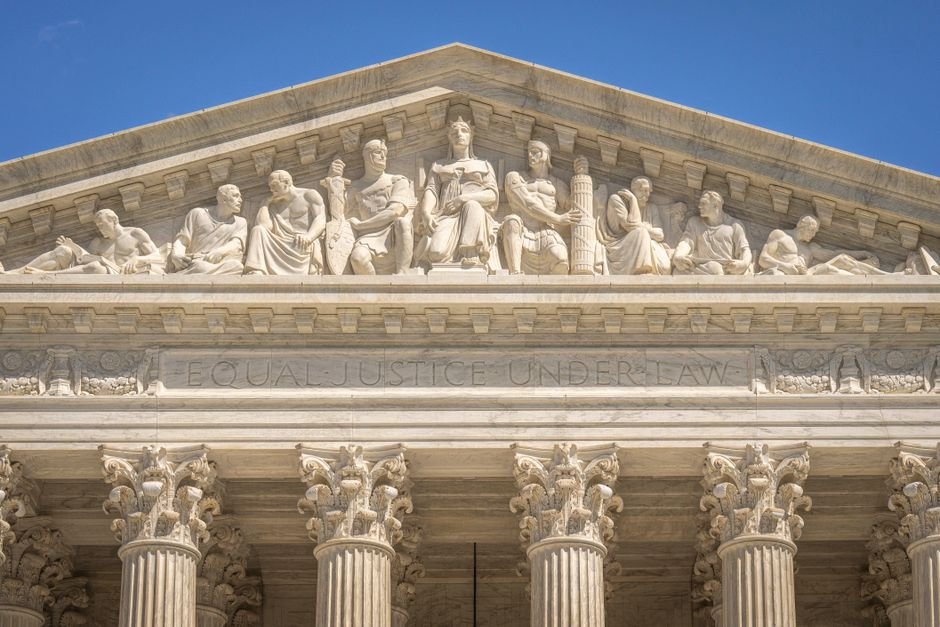
The escalation has started again. President Trump on Monday announced 50% tariffs on most Canadian goods, declaring that Canada unfairly discriminated against American autos, alcohol, and dairy products. But the legal foundation for this move is entirely different from the one the Supreme Court struck down in February, and that raises the question of whether the justices will have to rule on it again.
The Supreme Court ruled 6-3 in February that Trump lacked the authority to impose sweeping tariffs under the International Emergency Economic Powers Act, or IEEPA. Chief Justice John Roberts wrote that “based on two words separated by 16 others in IEEPA, ‘regulate’ and ‘importation’, the President asserts the independent power to impose tariffs on imports from any country, of any product, at any rate, for any amount of time.” The court said no.
So Trump’s team went back to the legal drawing board and found another tool: Section 338 of the Tariff Act of 1930, a Great Depression-era law that allows the president to impose duties on countries that discriminate against US commerce. The law has rarely been used in modern history. Several Democratic lawmakers proposed repealing it last year precisely because they feared Trump would use it to destabilize the economy.
“We crossed the Rubicon,” said Scott Lincicome, vice president of general economics at the Cato Institute. “The invocation of 338 is the nuclear option for Trump tariffs.”
The new 50% tariffs would apply to most Canadian goods except energy products, potash, fish, and critical minerals. Crucially, they would include goods previously protected by the United States-Mexico-Canada Agreement, the 2020 trade pact that the US did not renew. The tariffs take effect in 30 days, leaving a window for negotiation.
The legal question now is whether Section 338 survives Supreme Court scrutiny. The February ruling was specifically about IEEPA, not about the Tariff Act of 1930. But the major questions doctrine that the court applied to strike down the IEEPA tariffs, the idea that Congress must speak clearly if it wants to delegate power over matters of vast economic significance, could apply to Section 338 as well.
The Cato Institute’s Lincicome noted that the use of a Depression-era law to impose tariffs broadens the risks beyond Canada, injecting “massive uncertainty” into the global economy. If the administration can use Section 338 against Canada, it can use it against any trading partner.
The economic stakes are high. Tariffs are taxes on imports, and companies pass costs to consumers. Trump’s “Liberation Day” tariffs last year provoked a financial market meltdown, forcing him to walk back rates for negotiation. With midterm elections for Congress in November, the political calculus is treacherous.
Ontario Premier Doug Ford called for retaliation: “If these tariffs proceed, Canada should respond tariff for tariff, dollar for dollar.” The Canadian federal government did not immediately comment.
The Supreme Court has already ruled once that Trump overreached on tariffs. The question now is whether Section 338 gives him a path the court will accept, or whether it, too, exceeds what the Constitution allows a president to do without Congress. The court may have to answer that question sooner rather than later.