

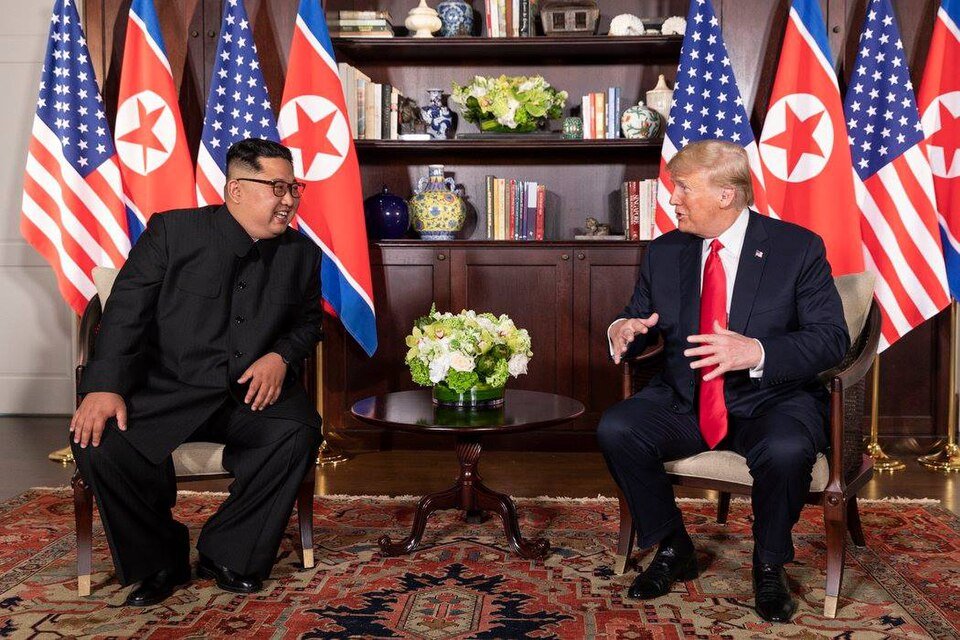
The image that defined Donald Trump’s first-term North Korea policy was a handshake across the demilitarized zone. The summit in Singapore, the letters exchanged with Kim Jong-un, the theatrical walk into the South, it was all choreography, heavy on gesture and light on substance. The substance, when it finally arrived, was nothing. Hanoi collapsed. Stockholm went nowhere. And the weapons program that was supposed to have been frozen kept expanding underground.
Now, at the G7 summit in France, Trump has signaled that the time has come to try again. But the landscape he is returning to is far more dangerous than the one he left.
According to South Korean President Lee Jae Myung, who met Trump on the margins of the G7, the American president appeared open to a phased approach to North Korea’s nuclear program. The phrase ‘phased approach’ matters. In Trump’s first term, the administration demanded a ‘big deal’, complete, verifiable, irreversible denuclearization before any sanctions relief. North Korea refused. Kim Jong-un has rejected denuclearization talks outright since 2019, and there is no evidence his position has softened. What has changed is the reality on the ground and the calculus in Washington.
The Congressional Research Service, in its most recent assessment, paints a grim picture. North Korea can now target the US homeland with intercontinental ballistic missiles. Enrichment facilities at Yongbyon and Kangson have been expanded, and intelligence indicates Pyongyang is building a probable additional enrichment site. This is not the North Korea of 2018, when the regime had tested a supposed hydrogen bomb but had not yet demonstrated the ability to reach the continental United States reliably. This is a nuclear state with a growing arsenal and an improving delivery capability.
A phased approach, then, would essentially be an acknowledgment that complete denuclearization is not achievable in the near term. What it might look like in practice: a freeze on further enrichment and weapons testing in exchange for partial sanctions relief, capped by a verification mechanism. This is the model that arms control experts have pushed for years, the so-called ‘freeze-for-freeze’ framework, and it is the approach that North Korea itself has consistently demanded. Trump’s apparent openness to it represents a significant departure from US orthodoxy.
But there is a complication that did not exist in 2018, and its name is Russia.
Moscow is now expanding nuclear and missile technology sharing with Pyongyang in return for North Korean artillery shells and short-range missiles used in the Ukraine war. The technological transfer is not theoretical. Russia has the expertise to help North Korea refine its re-entry vehicle designs, improve its solid-fuel missile technology, and potentially assist with submarine-launched ballistic missile development. A phased approach that freezes North Korean capabilities cannot account for capabilities that are being transferred from outside, unless that transfer is also addressed, and Russia has no incentive to stop.
The Russia-North Korea axis challenges any diplomatic approach, phased or otherwise. Every concession the United States offers to freeze North Korea’s program is a concession that Russia can help North Korea bypass. Every verification mechanism that monitors Yongbyon cannot monitor what leaves a Russian laboratory.
South Korea’s Lee Jae Myung has asked Trump to lead diplomatic efforts similar to his reported mediation with Iran. The comparison is instructive. The Trump administration’s approach to Iran was maximum pressure followed by direct talks, culminating in a framework that did not eliminate Iran’s nuclear infrastructure but placed caps on enrichment and imposed intrusive inspections. A North Korea version would look similar: a ceiling on fissile material production, a moratorium on long-range missile testing, and a return of international inspectors to Yongbyon. In exchange, North Korea would receive sanctions relief, energy assistance, and a pathway toward normalization.
The question is whether Kim Jong-un would accept even that. He has spent six years since Hanoi building exactly the arsenal he was told he could not have. The enrichment centrifuges in Kangson are spinning. The missiles in the silos are real. And he has watched Russia prove that a nuclear state can defy the international community with impunity, so long as it has a patron with a UN Security Council veto.
Trump may be sincere in wanting a new approach. He may even be right that the old one failed. But a phased approach works only when both sides have room to move. Right now, North Korea is moving in only one direction, upward in capacity and outward in range, and it has a new partner helping it get there faster than any negotiator can keep pace.