

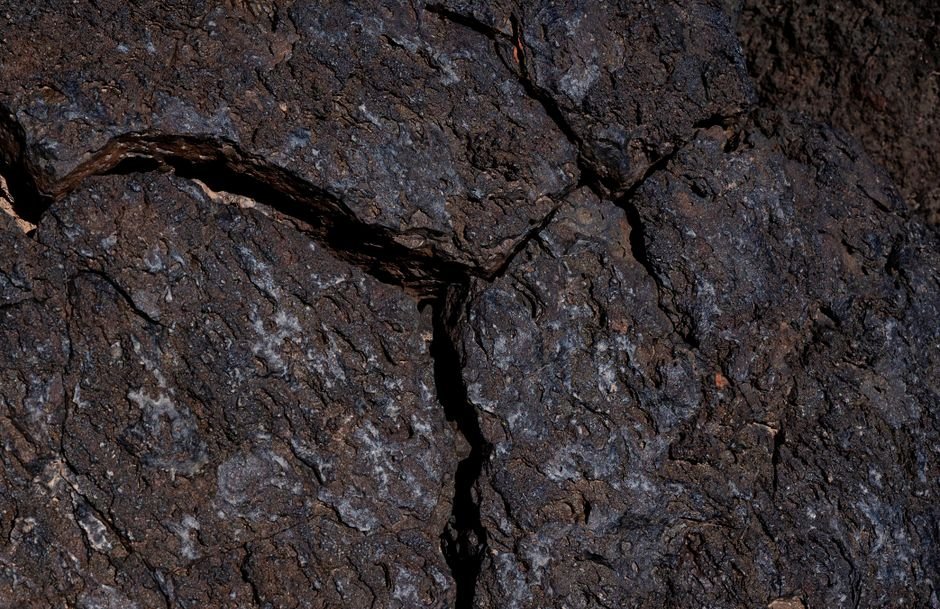
NASA’s Perseverance rover, now exploring the western rim of Jezero Crater, has uncovered a 75-meter (245-foot) thick stack of layered bedrock that preserves a direct record of the solar system’s most violent era. The formation, called the “Broom Point member,” contains evidence of multiple asteroid impacts from roughly 3.9 billion years ago, offering scientists an unprecedented window into the Late Heavy Bombardment.
Since leaving the Jezero Crater floor in late 2024, Perseverance has climbed into terrain that predates the crater itself. Because Mars lacks plate tectonics, its ancient crust has not been recycled and deformed the way Earth’s has. What remains is a geological archive that our own planet erased billions of years ago.

Perseverance’s selfie at Witch Hazel Hill on the Jezero Crater rim. Credit: NASA/JPL-Caltech/MSSS
Six Rock Types, One Violent History
The Broom Point member comprises six distinct rock types arranged in alternating layers: angular fragments called breccias, fine-grained rock dust, and dark glass beads. The glass beads are particularly telling. They form only under extreme heat, either from volcanic eruptions or high-energy impacts, and the largest examples are comparable in scale to the ejecta from the Chicxulub impact that wiped out the dinosaurs.
“The different rock layers are a record of variable-sized impacts occurring at different distances from where this rock sequence was accumulating,” said Alex Jones, a Ph.D. student at Imperial College London and lead author of the study published in the Journal of Geophysical Research: Planets. “Some large impacts took place very far away, some small impacts nearby. Their debris all ended up landing here, constructing this thick section of rock.”
The breccia fragments contain cavities from gas bubbles, confirming they were once molten. Their repeated appearance across multiple layers indicates the site endured multiple high-energy impact events over an extended period.
A Window Into the Late Heavy Bombardment
The Late Heavy Bombardment, spanning roughly 4.1 to 3.8 billion years ago, was a period when the inner solar system was pummeled by asteroids and planetesimals. Evidence for this era exists on the Moon and Mercury, both of which preserve ancient cratered surfaces, but Mars offers something unique: a stratified, layered record of how those impacts unfolded over time.
Ken Farley, Perseverance Deputy Project Scientist at Caltech, emphasized the significance: “Since leaving Jezero, Perseverance has been exploring a brand-new frontier, both geographically and geologically. On Earth, our earliest geologic history has been fundamentally broken up, deformed, and erased by plate tectonics. Because Mars lacks plate tectonics to recycle its crust, this ancient record remains intact, giving us a rare glimpse into a geological time period that does not exist on our own planet.”
Unusual Tilts and Water Interactions
Some rock layers in the Broom Point member display a near-vertical tilt exceeding 80 degrees, far too steep to have been caused by the same impact that created Jezero Crater itself. The researchers propose a two-stage sequence: first, a massive asteroid collision formed the Isidis Basin, a 1,900-kilometer (1,200-mile) wide structure and one of the largest impact basins on Mars. A second, later impact created Jezero Crater, fracturing and uplifting the already-tilted rocks into their current configuration.
Other layers suggest formation from rapid debris flows, possibly triggered when molten rock struck water or ice, generating instant steam explosions. If confirmed, this would indicate that water or ice was present in the region during the bombardment era, carrying implications for both Mars’s geological history and its potential for past habitability.
Why Mars Matters for Planetary History
Mars preserves what Earth cannot. Our planet’s active geology has erased nearly all traces of the first 500 million years of its history. The Broom Point member fills in some of those missing pages, providing a direct, stratified record of the bombardment that shaped every inner solar system world.
The findings also connect to similar features observed on the Moon and Mercury, helping scientists construct a unified timeline of early solar system evolution. As Perseverance continues its climb along the Jezero rim, researchers expect the rover to encounter even older terrain, pushing the window further back into Mars’s early history.