

Date: 2026-06-19
Featured image: Katalyst Space’s Link robotic servicing satellite awaits encapsulation inside a Northrop Grumman Pegasus XL rocket on June 8, 2026, at NASA’s Wallops Flight Facility in Virginia. Credit: NASA/Ron Beard
Just 10 months ago, NASA asked three companies if they could do something nobody had done before: build and launch a satellite to save a $500 million astronomy mission at risk of crashing back to Earth, in less than a year on a tight budget. On June 27, the answer will launch from a runway in the South Pacific.
Katalyst Space Technologies, a Colorado-based startup founded in 2020, won a $30 million NASA contract in September 2025 to chase down the aging Neil Gehrels Swift Observatory, latch onto it with three robotic arms, and boost it back to a safe altitude. The company’s Link servicing spacecraft is now integrated with Northrop Grumman’s Pegasus XL rocket at NASA’s Wallops Flight Facility in Virginia and has already begun its multi-day journey to Kwajalein Atoll in the Marshall Islands for launch.
“This is a success already, just from the fact that we’re even going to try this,” said Shawn Domagal-Goldman, director of NASA’s astrophysics division.
### Swift’s ticking clock
The Swift observatory launched in November 2004 on a mission to detect gamma-ray bursts, the most powerful explosions in the known universe. Despite its age, astrophysicists still rely on Swift’s multi-wavelength instruments to identify and locate these bursts for follow-up observations by observatories around the world and in space.
But Swift has a critical flaw for a spacecraft its age: it lacks any thrusters to maintain its orbit. Aerodynamic drag from the outermost layers of Earth’s atmosphere has gradually caused its altitude to decay from an initial 585 kilometers (363 miles) to just 363 kilometers (225 miles) as of June 18. The decay rate is accelerating as the spacecraft dips into denser atmospheric layers.
Recent extraordinary solar activity has compounded the problem. An active Sun puffs up Earth’s atmosphere, creating higher drag for satellites in low Earth orbit. Swift is losing altitude faster than anticipated.
NASA engineers estimate Swift will fall below 300 kilometers (186 miles) this fall, perhaps around October. At that altitude, increasing atmospheric drag will make it too dangerous for any spacecraft to approach. The launch window closed in June.
“This was not just any spacecraft,” Domagal-Goldman said. “This is an observatory with unique capabilities for astrophysics … So we decided, yeah, we want to go save this one, this time, because of how special it is.”
### Katalyst’s Link spacecraft
Katalyst Space Technologies built the Link spacecraft as a roughly 400-kilogram servicing vehicle equipped with three robotic arms, each carrying a lidar sensor for precision ranging and a mechanical gripper. The satellite must autonomously rendezvous with Swift more than 200 miles above Earth and grab hold of an observatory never designed to be serviced, with no docking port, grappling ring, or cooperative fixture.
The challenge required extensive detective work. Katalyst’s team pored over pre-launch photographs of Swift and consulted with NASA and Northrop Grumman engineers to identify safe capture points on the 22-year-old spacecraft. Swift’s sensitive optics cannot be pointed toward the Sun, Earth, or Moon without risk of damage, adding further constraints on approach geometry.
“There’s a lot of really fun detective work going on behind the scenes, in order to determine what points on the spacecraft we can actually capture and what the states are going to be,” said Kieran Wilson, Link’s principal investigator at Katalyst.
After a successful capture, Link will use its xenon-fueled Hall-effect thrusters to haul Swift back to approximately 600 kilometers, restoring the orbit that sustained the observatory for 22 years and buying it a similar extension.
### Racing the calendar
The compressed timeline defined every aspect of the mission. NASA bypassed its normal multi-year solicitation process entirely. “We didn’t send out a solicitation because we didn’t have time to,” Domagal-Goldman said. Instead, the agency asked three teams already under contract for technology development to study what they could do.
Katalyst was already working on a commercial demonstration mission for its Link platform. Upon selection, the company pivoted its private investment to meet NASA’s needs, placing orders for all parts simultaneously rather than sequentially. When suppliers could not deliver in time, Katalyst built the components themselves. Engineers streamlined the test campaign to fit the schedule.
“We’re in an unusual situation where the schedule dictates how much risk we’re willing to accept, rather than the other way around,” Wilson said. “The clock is ticking on Swift’s descent.”
The spacecraft shipped from Katalyst’s Colorado factory to NASA’s Goddard Space Flight Center in Maryland for thermal vacuum and vibration testing this spring, then to Wallops for integration with the Pegasus XL.
### The final Pegasus flight
The choice of launch vehicle followed directly from orbital mechanics. Swift orbits at an inclination of 20.6 degrees, tracking a path 20.6 degrees north and south of the equator. Most small launch vehicles operated from U.S. ground facilities cannot reach this inclination without overflying populated areas.
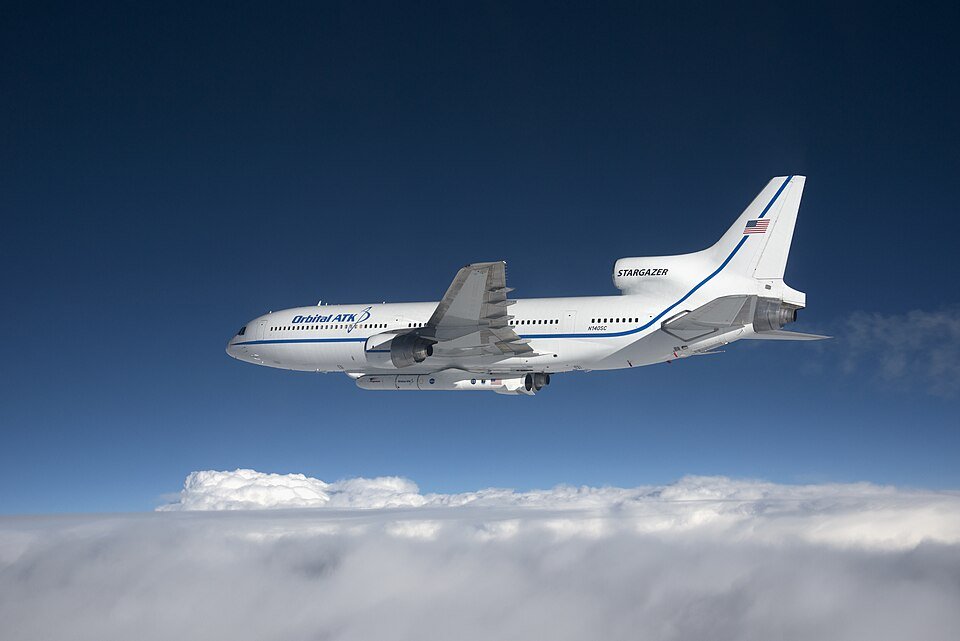
Northrop Grumman’s Pegasus XL eliminates the fixed-pad constraint entirely. The 17-meter (58-foot) rocket is carried aloft by a modified Lockheed L-1011 aircraft named Stargazer, released at approximately 12,000 meters (40,000 feet), and ignited five seconds after drop. Its distinctive delta-shaped wing provides aerodynamic lift during the 10-minute ascent to orbit.
By staging the drop from Kwajalein Atoll near the equator, Stargazer can release Pegasus on a trajectory that matches Swift’s inclination without overflying any populated region. Katalyst CEO Ghonhee Lee described Pegasus XL as “the only launch vehicle that can meet the orbit, the schedule, and the cost to achieve something unprecedented with emerging technology.”
This is the final Pegasus rocket scheduled to fly. The last two vehicles were originally ordered by Stratolaunch, the company founded by the late Microsoft co-founder Paul Allen. After Allen’s death in 2018, Northrop Grumman took possession of the rockets and sold one to the U.S. Space Force in 2021 and the other to Katalyst.
### A blueprint for responsive space
Whatever happens after launch, NASA and its partners believe they have written a new template for responsive space operations. The mission represents the first attempt by a commercial spacecraft to capture an uncrewed government satellite not designed for servicing.
“Some would call it the first of its kind, a robotic spacecraft that can go and capture an unprepared satellite,” said Robert Lamontagne, vice president for strategic partnerships at Katalyst. “It’s a commercial mission, first and foremost. It’s doing an operational, real-world objective. It’s not just a demonstration, and we’re doing this as a service. This is really a blueprint for commercial and government partnerships.”
The mission draws a direct line to prior orbital servicing achievements, including Northrop Grumman’s Mission Extension Vehicle series, but differs fundamentally by targeting a spacecraft with no cooperative hardware. If successful, it could open a new category of commercial in-orbit services, from life extension to debris removal to orbital salvage.
“To be honest, no one thought it was going to be possible,” Domagal-Goldman said. “No one thought we would get as far as we’ve already gotten today.”