

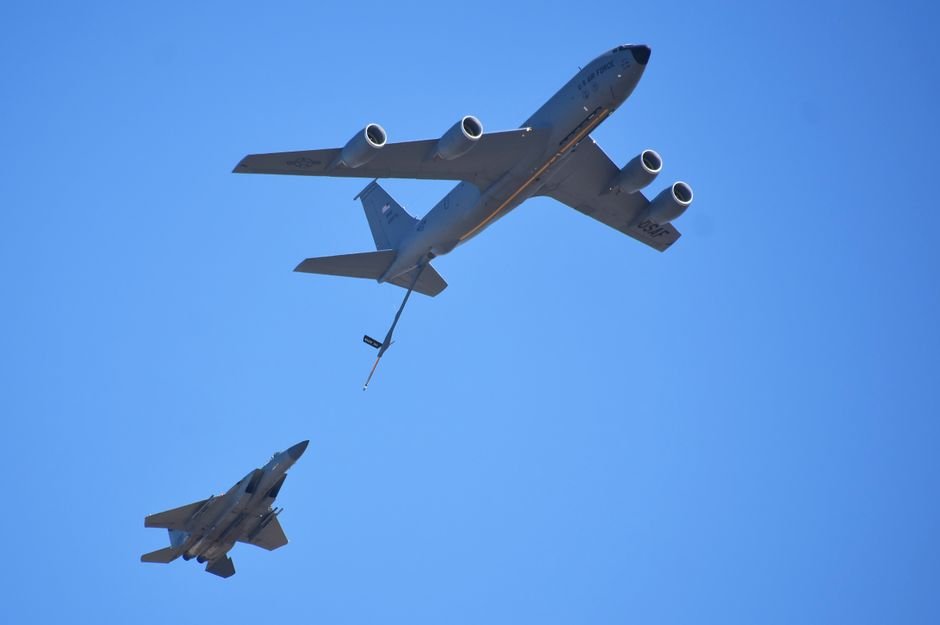
Washington has notified Israel it is sending dozens of additional aerial refueling aircraft to the country, as President Trump considers a major expansion of American military operations against Iran.
The decision follows a White House Situation Room briefing earlier this week in which military officials laid out several new options for striking Iran. Trump has not yet signed off on any specific plan, but according to American and Israeli officials who spoke to Axios, he appeared open to escalating far beyond the current campaign around the Strait of Hormuz.
The options presented include bombing Iranian power plants and other infrastructure, additional strikes on nuclear facilities deep enough to bury Tehran’s enriched uranium stockpile even further underground, and an attack on a site known as “Pickaxe Mountain,” where Iran is suspected of building a new underground nuclear facility. Officials said a decision could come within days.
The refueling planes are the logistics key to any deeper operation. The US military currently has about 30 tanker aircraft stationed at Ben Gurion Airport near Tel Aviv and roughly the same number at Ramon Air Base in southern Israel. Washington wants to send several dozen more in the coming days, restoring the total to the level seen when the war with Iran first began.
The US military prefers keeping most of its tankers at Ben Gurion because other regional bases sit closer to potential Iranian missile strikes and offer less protection. But the prolonged deployment of dozens of American military aircraft at Israel’s main international airport has already caused severe congestion, at times bringing civilian operations close to a standstill. Transportation Minister Miri Regev has pressed for moving the aircraft out of Ben Gurion or limiting their numbers. The Defense Ministry and IDF oppose restrictions, arguing the planes serve an essential operational purpose.
The Trump administration has formally asked the Israeli government to approve the arrival of additional refueling aircraft. Prime Minister Benjamin Netanyahu is expected to make the final call.
The expanded planning comes as the US military wraps up a seventh consecutive night of strikes on Iranian targets. The latest attacks have hit at least seven bridges around Bandar Abbas, a major IRGC operations center near the Strait of Hormuz, cutting supply lines used to move ammunition, reinforcements, and equipment to Iranian forces around the strategic waterway.
Iran has responded by intensifying attacks against American bases in Jordan, Qatar, Bahrain, Iraq, and Kuwait. The IRGC also claimed to have struck a US base in Syria, though American forces had withdrawn from that location months earlier.
Netanyahu addressed the escalation directly in a speech this week, warning Iran’s leadership against any attack on Israeli territory. “Do not count on it being quiet if you attack us,” he said. “Do not count on a rerun. Because it will not be a rerun, and that was already powerful enough. This will be a different event, much more powerful.”
For now, Iran is still holding back from striking Israel directly, likely out of concern that doing so would trigger an even heavier Israeli response. But with dozens more American tankers on the way and new strike options sitting on Trump’s desk, the question is no longer whether the war expands, but how far.