

Anthropic has joined Frontier, the advance market commitment for permanent carbon removal, becoming the first pure AI startup member of the coalition founded by Stripe, Google, Shopify, and Meta in 2022.
The announcement, made on June 17, coincides with Frontier’s launch of a “Growth AMC” that adds $915 million in new pledges from Stripe, Google, Shopify, Salesforce, H&M Group, and Anthropic. The new funding brings Frontier’s total commitments to $1.8 billion, nearly doubling the original $925 million pool from 2022.
Frontier, a public benefit LLC wholly owned by Stripe, functions as a pooled offtake buyer. Members contribute capital that Frontier uses to sign long-term contracts with carbon removal companies, guaranteeing future demand to help technologies scale. To date, Frontier has contracted roughly $700 million across more than 50 projects, securing 1.8 million tons of CO2 removal.
Seven portfolio companies broke ground on 1.4 million tons of new annual removal capacity in 2025. Frontier forecasts delivery will exceed 50,000 tons in 2026, doubling for the second consecutive year.
Anthropic’s participation is notable for several reasons. It is the first company whose primary business is AI to join the coalition (Google is a founding member but is a conglomerate with diverse revenue streams). Anthropic has not yet published a sustainability report or disclosed its emissions to the Foundation Model Transparency Index.
The company had previously signaled an “all of the above” approach to energy, a phrase associated with willingness to buy from polluting sources. Joining Frontier represents a shift in posture, even if the specific financial commitment was not disclosed.
Individual member contributions to Frontier are private.
The move comes at a moment when AI’s energy footprint is under intensifying scrutiny. Training large models and running inference across global data centers consumes enormous amounts of electricity. Neither Anthropic nor OpenAI has publicly disclosed emissions data, and the industry has been on an energy buying spree that has included controversial natural gas plant deals.
How the Growth AMC Works
Frontier’s Growth AMC represents a strategic shift from the initial fund. Where the original 2022 AMC was designed to get carbon removal off the starting line with many small bets, the Growth AMC focuses on 10 to 15 concentrated investments with 8- to 10-year offtake contracts extending to 2040.
New contracts must demonstrate a path to government subsidy or support. Frontier is targeting technologies with genuine gigaton-scale potential, meaning the ability to remove at least 1 billion metric tons of CO2 per year.
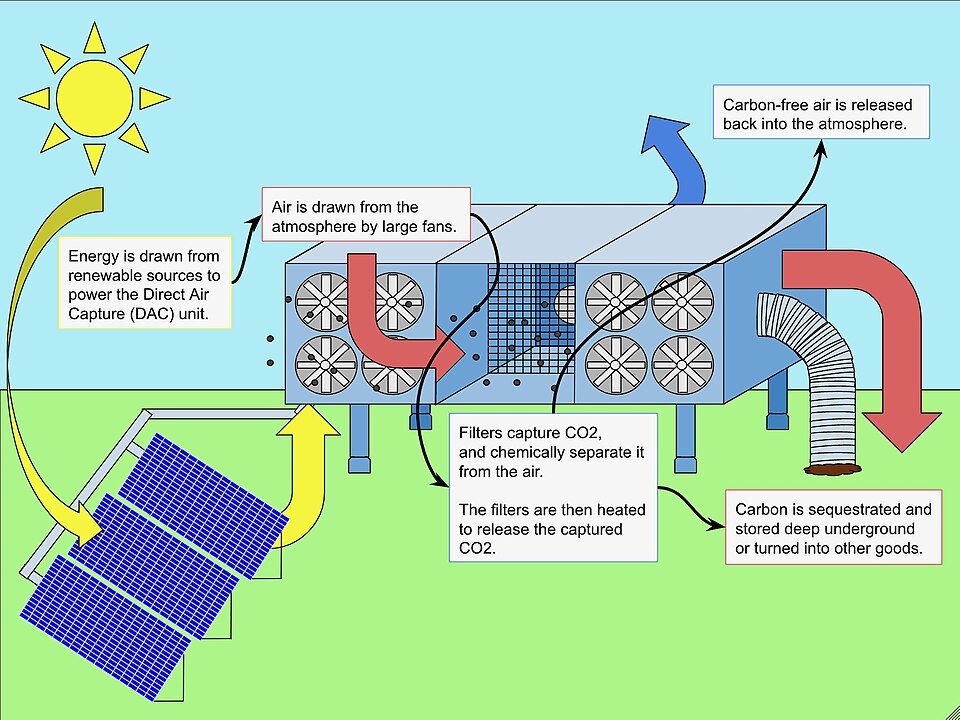
The technologies Frontier is backing span several pathways: direct air capture, ocean alkalinity enhancement, enhanced rock weathering, biomass carbon removal and storage, and surficial mineralization. Each has different cost profiles and scale constraints.
Hannah Bebbington Valori, Head of Frontier, said the shift reflects the coalition’s maturation: “We’ve proven that carbon removal technology can work. The most important questions for each pathway are now how big it can get, how cheap it can get, and whether it can be deployed responsibly at scale.”
The Carbon Removal Market Context
The new funding arrives at a critical moment for the carbon removal industry. In April 2026, reports that Microsoft was slowing its carbon removal buying sent ripples through the sector. Frontier’s $915 million injection was widely welcomed as a signal that institutional demand remains strong.
The IPCC has stated that carbon removal is necessary for achieving net-zero emissions. The Science Based Targets initiative, in a June 2026 update, now requires companies to use removals for a growing share of ongoing emissions from 2035 onward.
For Anthropic, joining Frontier is one step toward addressing the tension between AI’s growing energy demands and the industry’s limited climate accountability. The company has not disclosed how much it is contributing, and it has not yet set a public emissions target. But the signal is clear: even AI companies still figuring out their own footprint are beginning to pay for the cleanup.
Sources: TechCrunch (June 17, 2026); Frontier blog (June 17, 2026); ESG Today (June 17, 2026)