

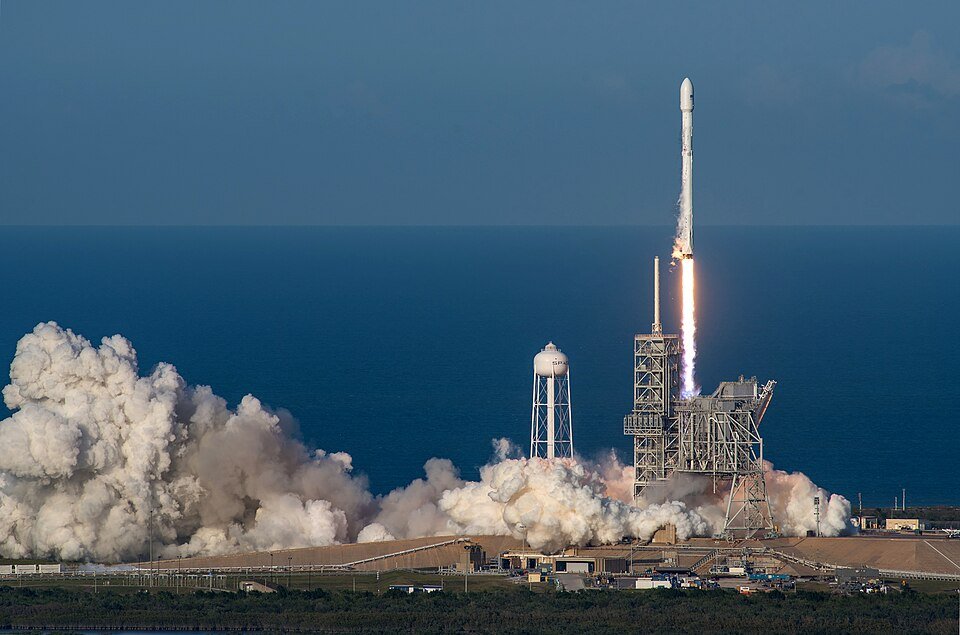
China executed four orbital launches in three days across four different rocket families, underscoring the country’s accelerating launch cadence in 2026. But the flurry of missions was tempered by an extended period of silence following the liftoff of a Kuaizhou-11 solid rocket from the Jiuquan Satellite Launch Center, suggesting possible issues with the vehicle or its payloads.
The four-mission campaign began June 14 Eastern time with a CAS Space Kinetica-1 (Lijian-1) solid rocket lifting off from the Dongfeng Commercial Aerospace Innovation Test Zone at Jiuquan. The launch successfully placed eight Jilin-1 Earth observation satellites into orbit for Changguang Satellite, the commercial remote sensing arm of the Chinese Academy of Sciences. The payloads included Wenwu-01 (Jilin-1 Gaofen 04D01), a high-resolution optical satellite built jointly with the National Cultural Heritage Administration for cultural heritage site monitoring. Changguang Satellite reported that Jilin-1 Gaofen-07C04 features onboard deep-fusion processing, autonomous mission planning, and sub-0.5-meter resolution. CAS Space claimed the milestone of being the first private Chinese launch provider to orbit 100 satellites with the Kinetica-1 vehicle, which has now flown 14 times.
A Long March 3B lifted off on June 16 from the Xichang Satellite Launch Center in southwest China, marking a return-to-flight after the workhorse rocket suffered a failure on January 16 due to a third-stage anomaly. The China Aerospace Science and Technology Corporation (CASC) confirmed the launch succeeded, identifying the payload as Shijian-31, described as being “mainly used for space environment exploration.” The Shijian series has historically been associated with experimental and demonstration missions, including on-orbit refueling tests. US Space Force tracking later placed Shijian-31 in a Molniya orbit, joining China’s Shiyan-10 and TJS-21 satellites in the highly elliptical orbit regime. The January failure had knock-on effects for the Long March 7A, which shares the same hydrolox third stage.
### Kuaizhou-11 Silence Raises Questions
The most closely watched mission of the campaign was the Kuaizhou-11 solid rocket, which lifted off at approximately 11:40 p.m. Eastern on June 17 (0340 UTC) from Launch Area 95A at Jiuquan. While Chinese social media posts confirmed the launch had occurred, hours passed without any official statement from CASC or Expace, the CASIC subsidiary that operates the Kuaizhou rocket family. Such prolonged silence typically precedes the announcement of a launch failure or problems with one or more payloads.
The US Space Force later tracked the Kuaizhou-11 rocket body in a 189-by-885-kilometer (117-by-550-mile) orbit at 55 degrees inclination, confirming the vehicle reached orbit and performed a perigee-lowering burn. However, no data has been reported on the deployment of payloads from the mission, and Chinese authorities have yet to issue an official statement. Gunter’s Space Page, a widely referenced launch-tracking database, lists the June 17 Kuaizhou-11 mission as a failure.
The Kuaizhou-11 is a three-stage solid-propellant rocket developed by Expace as a larger variant of the Kuaizhou-1A. With a gross liftoff mass of 78 metric tons and a payload capacity of approximately 1,500 kilograms (3,300 pounds) to low Earth orbit, the vehicle is roughly five times more powerful than its predecessor. The 25-meter-tall rocket uses a mobile transporter-erector-launcher (TEL) truck, enabling rapid deployment from non-traditional launch pads. It draws from the DF-21 intermediate-range ballistic missile lineage and is designed for quick-reaction satellite replacement scenarios.
The Kuaizhou-11’s first flight in July 2020 ended in failure when the third stage failed to ignite. The vehicle was initially declared retired in April 2022, but a successful return-to-flight in December 2022 was followed by three more successful missions, most recently a rideshare launch in March 2026. If the latest mission proves to be a failure, the impact on China’s broader launch plans would likely be limited given Expace’s supplementary role in the national launch ecosystem.
### Long March 12 Expands Guowang Constellation
Just hours before the Kuaizhou-11 launch, a Long March 12 rocket lifted off from the Hainan Commercial Space Launch Site at 10:44 p.m. Eastern on June 17 (0244 UTC). CASC confirmed the mission’s success, stating the payloads were the 22nd group of satellite internet low Earth orbit satellites for the national Guowang broadband constellation.
The Long March 12 has now flown six times since its debut in November 2024. Based on the pattern of nine satellites per previous Long March 12 Guowang deliveries, approximately 177 Guowang satellites are now in orbit for the 13,000-satellite program. The rocket uses a horizontal assembly, test, and transport processing mode and is rated for at least 12,000 kilograms (26,500 pounds) to low Earth orbit and 6,000 kilograms (13,200 pounds) to a 700-kilometer (435-mile) sun-synchronous orbit.
### China’s Launch Pace Accelerates
The four launches bring China’s total orbital launch attempts in 2026 to 43, including three confirmed failures (with the Kuaizhou-11 status pending). June alone has seen nine launch attempts. One earlier mission this month, a Zhuque-2E launch of direct-to-device test satellites, saw its upper stage break up in orbit on June 9, creating 100 to 150 debris pieces tracked by US Space Forces-Space.
China is aiming to surpass the 100-launch mark for a calendar year for the first time in its history in 2026, while also debuting potentially reusable launchers with much greater payload capacity. Upcoming missions include a Long March 7A from Wenchang on June 23 and a Long March 8A from the Hainan commercial spaceport on June 27.