

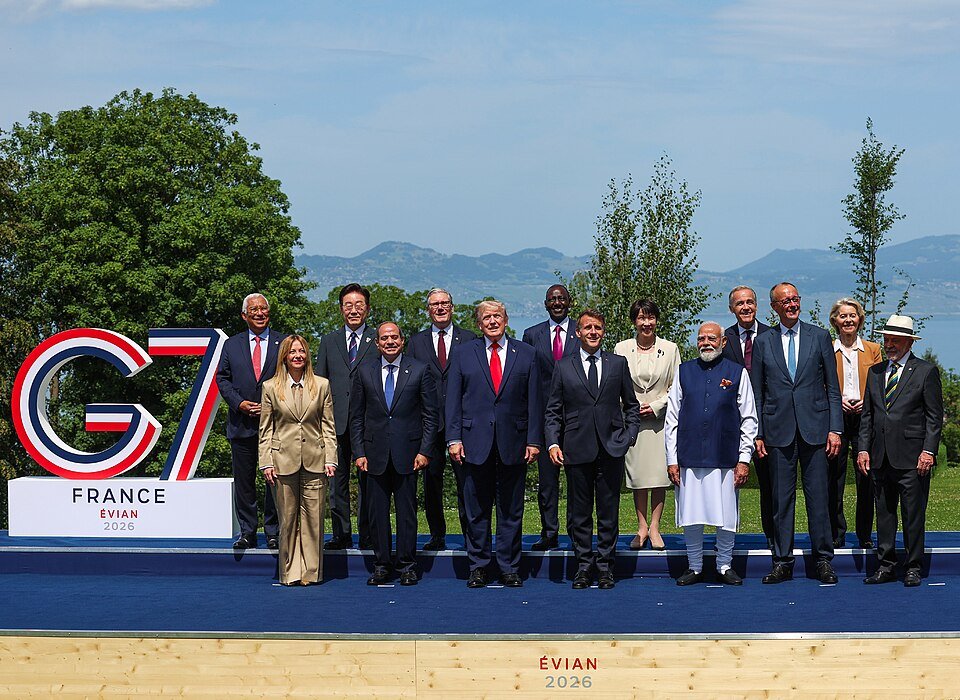
The last day of the G7 summit in Evian-les-Bains produced a cascade of events that capture the fragility of the peace the world is hoping for. On the same Wednesday the seven leaders welcomed the US-Iran framework deal and called for a ceasefire in Lebanon, the American president warned he would “go back to shooting” at Iran, Israeli jets struck southern Lebanon, and the first Iranian oil tankers in two months sailed out of the US blockade zone.
Each of these stories is true. Together, they describe a peace that is not yet settled, a deal that is not yet final, and a region where everyone is acting on different assumptions about what the agreement actually means.
G7 leaders demand Lebanon ceasefire
The summit’s closing statement was the most unified thing to come out of Evian. The G7 leaders welcomed the US-Iran framework deal, called for an immediate ceasefire in Lebanon, and committed to diversifying energy supply routes to reduce dependence on the Strait of Hormuz.
“We underline the need for the negotiation to address the threats posed by Iran in the region and beyond and ensure that they never obtain a nuclear weapon,” the leaders said in their statement.
The language on Lebanon was direct. The G7 demanded that hostilities between Israel and Hezbollah stop, echoing the Trump administration’s own stated position. But the statement papered over a division that was visible all week: European leaders wanted the summit to focus on Ukraine and push Trump harder on Russia; Trump wanted to talk about his Iran deal and move on.
The summit ended with a public show of unity and a private recognition that the gaps between the US and its closest allies remain wide. Macron described it as a “moment of strategic awakening” for Europe, but that is a phrase that carries more hope than substance.
Trump: ‘If I don’t like it, we’ll go back to shooting’
Hours after the G7 statement was released, President Trump undercut his own deal. Speaking to reporters, he warned that the agreement with Iran was conditional and that Washington reserved the right to resume military operations.
“If I don’t like it, we’ll go back to shooting,” Trump said on Wednesday. He added that the deal was “not final” and that the US would watch closely to see if Iran “behaves.”
The remark was vintage Trump: it allows him to claim credit for the agreement while simultaneously distancing himself from any outcome he does not like. But it sent a destabilizing signal at precisely the moment when the framework was supposed to create certainty. Iranian negotiators are heading to Switzerland this week to begin 60 days of talks on the nuclear program. Reading in the press that the American president is already threatening to resume bombing does not create the negotiating climate the deal was meant to produce.
Israel strikes Lebanon anyway
While Trump was threatening Iran from Evian, the Israeli military was striking southern Lebanon. The strikes targeted vehicles near the town of Nabatieh, killing four people according to Lebanese state media. The Israeli military said it struck after “identifying a suspicious vehicle” near where its soldiers were operating and that its forces had intercepted rockets and struck a launcher.
The timing was pointed. On Tuesday, Trump had publicly criticized Netanyahu, saying the Israeli prime minister “has to be more responsible with respect to Lebanon.” The G7 leaders followed with their ceasefire call. Israel responded by bombing anyway.
This is the structural problem at the heart of the peace process. The US-Iran deal is supposed to include a ceasefire in Lebanon — Iran has claimed this, and Pakistan’s mediators have confirmed it. But Israel is not a party to the agreement, and Netanyahu has made clear he will pursue operations against Hezbollah regardless of what Washington and Tehran sign. On Wednesday, Iran’s central military command warned that Israel should “await a harsh response” to the Nabatieh strikes.
The war in Lebanon has killed more than 3,700 people, displaced over a million, and drawn in the IRGC, Hezbollah, and the Lebanese state. It cannot be resolved by a US-Iran framework that Israel refuses to acknowledge.
Iranian tankers exit the blockade
The one unambiguous piece of good news came from the water. TankerTrackers, the maritime intelligence firm, reported that the first Iranian crude oil tankers had exited the US Navy blockade zone in the Gulf. Two National Iranian Tanker Company supertankers — the DIONA and HERO2 — sailed out carrying a combined 3.8 million barrels of crude oil, the first Iranian exports in two months. A third tanker followed shortly after.
The sailings were the clearest sign yet that the US blockade is being lifted in practice, not just on paper. Under the framework deal, the US will issue sanctions waivers allowing Iran to sell oil freely during the 60-day negotiating window. The Wall Street Journal reported that the waiver will also cover banking, transportation, and insurance services.
Oil markets responded accordingly. Brent crude continued its slide, settling below $87 a barrel as traders priced in the return of Iranian supply. Saudi Aramco CEO Amin Nasser has warned that full normalization will not happen before 2027, but the market is moving faster than the infrastructure.
What it adds up to
A single day in the Middle East produced all four of these events. A unified G7 statement, a presidential threat to resume bombing, Israeli airstrikes on Lebanon, and Iranian oil tankers sailing free. Each is real. Each carries its own logic. Each pulls in a different direction.
The deal Trump announced is real enough to move oil prices and send tankers through the strait. But it is fragile enough that the American president is already threatening to tear it up, and the Israeli prime minister is already testing its limits. Sixty days of nuclear talks in Switzerland will decide which version of this peace wins out — the one that holds, or the one that shatters on the first contradiction.