

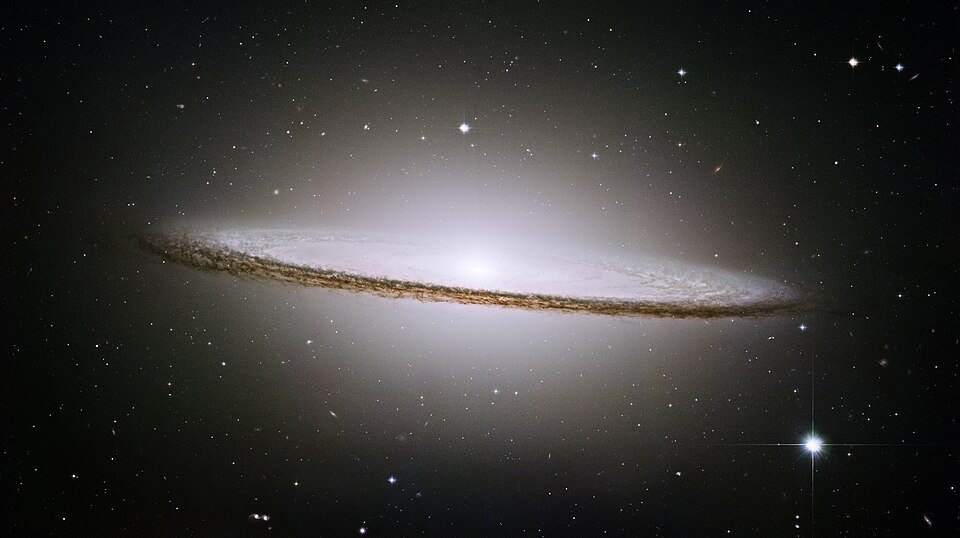
On June 10, 2026, the Science Programme Committee of the European Space Agency formally adopted a new space telescope with an ambitious and unusual assignment. Named ARRAKIHS — short for Analysis of Resolved Remnants of Accreted galaxies as a Key Instrument for Halo Surveys — the mission is designed to do one thing that no space telescope has ever been built to do before: map the faintest, most diffuse structures in the universe.
Those structures are the stellar halos and tidal streams that surround galaxies like the Milky Way. They consist of stars torn from dwarf galaxies that were consumed by larger galaxies long ago, stretched into ghostly arcs and ribbons that orbit in the dark matter halo at surface brightnesses a thousand times fainter than the background night sky. For most telescopes, these structures are invisible.
“The light from these halos is like a small flashlight in front of bright stadium floodlights,” said Rafael Guzman, the mission’s principal investigator at the Institute of Physics of Cantabria (IFCA) in Spain. “You have to design the entire observatory to suppress every possible source of stray light.”
ARRAKIHS is ESA’s second “F-class” (fast) mission — a category of smaller, lower-cost projects with a rapid development timeline. Its name is borrowed from the fictional desert planet in Frank Herbert’s Dune novels, chosen for its connotations of a harsh but revealing environment.
The telescope consists of two binocular cameras — four detectors in total — covering a continuous wavelength range from the near-ultraviolet (280 nanometers) through visible light to the near-infrared (1,600 nanometers). It uses detectors similar to those on the James Webb Space Telescope and ESA’s Euclid mission. The instrument has a surface brightness sensitivity limit of approximately 31.5 magnitudes per square arcsecond in visible bands, far deeper than any existing survey.
The spacecraft will weigh under 600 kilograms fully loaded, with a stowed size of roughly 1.5 by 1.5 by 1.2 meters. It is designed to fit within ESA’s standard small-launcher envelope.
The mission budget is 320 million euros. Spain is the lead country, with core partners including Switzerland, Austria, Belgium, Norway, Portugal, Sweden, and the United Kingdom. A total of roughly 48 institutions across 17 countries participate, including research groups from the United States, Thailand, and Taiwan. Launch is planned by the end of 2030, with a nominal science operations phase of three years.
Why halos matter
Every large galaxy is surrounded by a stellar halo — a sparse, roughly spherical distribution of stars that extends far beyond the visible disk. In the Milky Way, the halo contains some of the oldest stars known, but it is so faint that we see only its nearest portions.
The halo is also where the history of a galaxy’s growth is written. When a smaller galaxy falls into a larger one, its stars are gradually pulled apart by tidal forces, forming long streams that trace the orbit of the disrupted galaxy. These streams persist for billions of years, slowly dispersing into the general halo. By mapping them, astronomers can reconstruct the sequence of mergers that built a galaxy.
The connection to dark matter is direct. The streams orbit within the dark matter halo — the massive, invisible structure that dominates a galaxy’s gravitational potential — and their shapes and curvatures reveal its distribution. Streams that are sharply curved indicate a concentrated dark matter halo; straighter, more diffuse streams indicate a more extended one.
“We can infer from the shapes, the curvatures of these stellar streams, that there is a lot of dark matter,” said Ana Bonaca of the Carnegie Observatories, an external researcher quoted in the Science article announcing the mission.
Moving beyond the Milky Way
ESA’s Gaia mission has mapped the Milky Way’s halo and streams in extraordinary detail, revealing the remnants of ancient mergers like the Gaia-Sausage-Enceladus collision. But the Milky Way is only one galaxy.
“What if the Milky Way is just the weird galaxy?” Bonaca asked. “How much can we really learn about galaxy formation, or cosmology for that matter, just from this one?”
ARRAKIHS will target 80 to 100 Milky Way-like galaxies at distances of 50 to 130 million light-years, measuring their halo structures, stellar streams, and ultra-diffuse features at a level of detail that has been impossible from the ground. The survey will cover a range of galactic environments — isolated galaxies, group members, and potential future mergers — to test whether the Milky Way’s assembly history is typical or anomalous.
The results will provide a direct test of the prevailing cosmological model, Lambda-CDM, which makes specific predictions about the number and distribution of dark matter sub-halos and the frequency of galaxy mergers. If the dark matter halos around ARRAKIHS galaxies look different from what Lambda-CDM predicts, the model may need revision.
Synergies with Euclid and Gaia
ARRAKIHS is designed to work in concert with other ESA missions. Euclid, launched in 2023, maps dark matter through gravitational lensing at larger scales; ARRAKIHS will fill in the small-scale structure of individual galaxy halos. A joint study through the International Space Science Institute has already explored how the two data sets can be combined.
ESA Director of Science Carole Mundell described ARRAKIHS as a natural extension of the agency’s cosmology program, targeting structures that are too faint for any other instrument to see.
The telescope’s formal adoption clears the way for the industrial contract phase, with prime contractors AVS (Spain) and Redwire (Belgium subsidiary) leading the platform design and Satlantis building the instrument.
Sources:
- J. Bennett, “New space telescope will map galaxies’ ghostly halos and streams,” Science AAAS, June 17, 2026. DOI: 10.1126/science.z1ice3v
- ESA, “ARRAKIHS mission factsheet,” European Space Agency, June 2026
- ESA Science Programme Committee, “ARRAKIHS adoption announcement,” June 10, 2026