

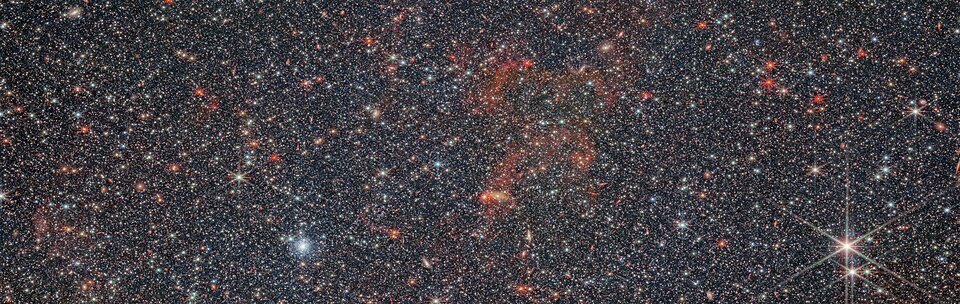
Astronomers have confirmed that the dense star cluster Terzan 5 is not a globular cluster at all, but a surviving fragment of the primordial clumps that merged to form the Milky Way’s bulge billions of years ago. The finding, presented at the 248th meeting of the American Astronomical Society and published in Astronomy & Astrophysics, establishes a new class of celestial object: “bulge fossil fragments.”
Using the James Webb Space Telescope’s near-infrared capabilities to peer through the thick dust of the galactic center, combined with 12 years of Hubble Space Telescope archival proper-motion data and ground-based spectroscopy from Keck and the Very Large Telescope, an international team led by the University of Bologna identified four distinct generations of stars within Terzan 5, dated with unprecedented precision to 12.5, 4.7, 3.8, and 2.5 billion years old.
The oldest generation, at 12.5 billion years, coincides with the era of the Milky Way’s own assembly. The two youngest populations — 3.8 and 2.5 billion years — are newly confirmed by this study.
“Weeb’s new near-infrared observations, cross-referenced with Hubble’s archival observations, have given us a much clearer picture of the history of Terzan 5,” said lead author Giorgia Zullo of the University of Bologna.
### Why Four Generations Matter
Ordinary globular clusters are simple objects: they formed from a single gas cloud in the early Universe and contain stars of essentially the same age. Terzan 5 is different. It was massive enough to retain the heavy elements, gas, and dust ejected by early supernovae, providing the raw material for subsequent rounds of star formation. In lighter globular clusters, supernova explosions blow those materials away, ending star formation after the first generation.
“For some reason, this peculiar clump of stars formed separately from the bulge and was not destroyed as the bulge itself formed,” said Francesco R. Ferraro, principal investigator at the University of Bologna.
The presence of four stellar generations also rules out alternative explanations such as a chance collision with a passing gas cloud or another cluster. Terzan 5’s multiple populations are the result of its own retained mass across billions of years.
### A Window Into Galaxy Formation
Galactic bulges are thought to form when gas disks in the early Universe fragment into massive clumps that migrate inward and merge. Webb has observed such “clumpy” galaxies at high redshifts, including the Firefly Sparkle galaxy. Terzan 5 provides a nearby laboratory to study the same process.
“Terzan 5 may provide direct evidence that can help explain how bulges formed in galaxies throughout the Universe,” said co-author Barbara Lanzoni of the University of Bologna.
Only one other object has been reclassified as a bulge fossil fragment: the star cluster Liller 1. Ferraro’s team plans to survey 40 to 50 more globular cluster candidates in the galactic bulge to identify additional fragments.
### Fossil Record of Chemical Enrichment
The four stellar populations also preserve a chemical timeline. Each generation shows a distinct pattern of heavy element enrichment from successive supernova waves. “Along with the ages of these populations, the cluster preserves a fossil record of progressive enrichment of heavy elements by supernovae,” said co-author R. Michael Rich of UCLA.
The research was published in Astronomy & Astrophysics and is available at the A&A website under the reference aa59349-26. The work combines contributions from the Webb (NIRSpec, MIRI) and Hubble Space Telescopes.