

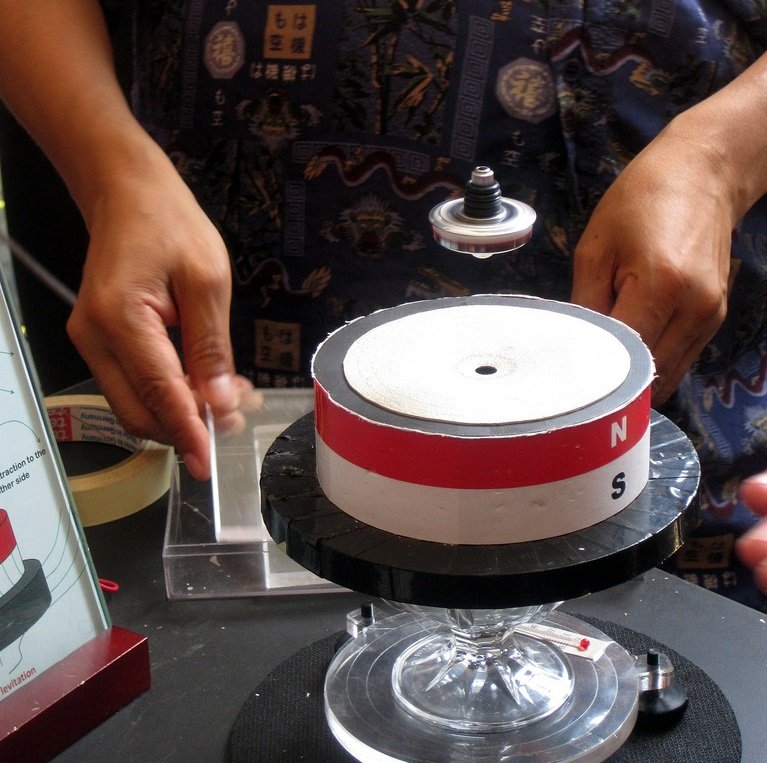
Scientists have used a sensor no larger than a few cubic centimeters, built around a magnetically levitated particle, to detect the gravitational pull of the Moon and Sun on the Earth’s crust, demonstrating a new class of compact gravimeters that could transform geophysics, hazard monitoring, and planetary science.
The technique, known as diamagnetic levitation, uses a strong magnetic field to suspend a tiny test mass in midair, isolating it from mechanical vibrations and other sources of noise. By measuring the minuscule movements of the levitated particle, researchers at the University of Southampton detected the daily rise and fall of the Earth’s crust caused by the gravitational tides of the Moon and Sun, a phenomenon known as Earth tides.
The research, led by Tim M. Fuchs and colleagues, is described in a paper submitted to arXiv on June 2, 2026. The sensor, called a Levitated Mechanical Sensor (LOMS), achieved a demonstrated sensitivity of 18 micro-GAL, where one GAL is a unit of acceleration equal to one centimeter per second squared. Earth tides produce signals of 100 to 300 micro-GAL in amplitude.
Why this matters
Current state-of-the-art gravimeters are large, heavy instruments weighing more than 8 kilograms and costing over $100,000. Their size and expense limit them to fixed observatory installations or specialized field campaigns. The Southampton team’s sensor shrinks the entire system to a few cubic centimeters with a projected cost that could make gravity surveys as routine as aerial photography.
The sensor achieved an integration time of just 6 seconds, meaning it can produce a reading every few seconds rather than requiring hours of averaging. Its projected sensitivity of less than 200 nano-GAL per square-root hertz would represent a substantial improvement over existing instruments.
How diamagnetic levitation works
Diamagnetic materials are repelled by magnetic fields, though usually the force is far too weak to notice. By using the intense field of a superconducting magnet, typically 10 to 18 tesla, researchers can make the diamagnetic force strong enough to levitate small objects in midair.
Unlike optical levitation, which uses laser light to trap particles, diamagnetic levitation can support much heavier test masses, simplifying the detection setup and reducing costs. The levitated mass floats free of any mechanical support, isolating it from the vibrations and friction that would otherwise swamp the tiny gravitational signals being measured.
From lab prototype to field-ready instrument
The new work builds on a 2024 breakthrough published in Physical Review Letters by researchers at Nanjing University and the University of Science and Technology of China, who first demonstrated Earth tide measurement using a diamagnetic levitated micro-oscillator with a proof mass of just 215 milligrams. Their experiment achieved a correlation of 0.97 between measured and theoretical tide predictions, validating the approach.
The Southampton team’s sensor represents a significant step beyond that proof of concept, with improved sensitivity and a design better suited for real-world deployment. The authors expect the technology can be developed into instruments suitable for drone-based surveys at altitudes of 10 to 100 meters, distributed sensor networks, and even multipixel gravity imaging arrays.
Applications from volcanoes to sea level
Gravity mapping is a fundamental geophysical tool. Changes in mass distribution underground, whether from magma moving beneath a volcano, groundwater depletion, or ice sheet melting, produce tiny changes in local gravity that sensitive instruments can detect.
The ability to deploy gravimeters on drones would allow rapid surveys of volcanic edifices to detect magma movement before eruptions, or mapping of subsurface cavities and aquifers without the cost of ground-based surveys. Sea level rise, currently measured at about 3 millimeters per year, and ice mass loss, amounting to hundreds of gigatons annually, produce gravity signatures that a network of compact sensors could track.
Planetary connections
Earth tides themselves are caused by the same gravitational interactions that drive ocean tides: the pull of the Moon and the Sun stretching and compressing the solid Earth by tens of centimeters each day. Instruments that can measure these tiny deformations with high precision also have applications in planetary science, where similar techniques could be used to probe the interiors of the Moon, Mars, or asteroids from orbit or from landers.
The technology could also be relevant to fundamental physics. The extreme sensitivity of levitated sensors makes them candidates for tests of gravity at short ranges, searches for dark matter, and other experiments at the boundary between geophysics and particle physics.