

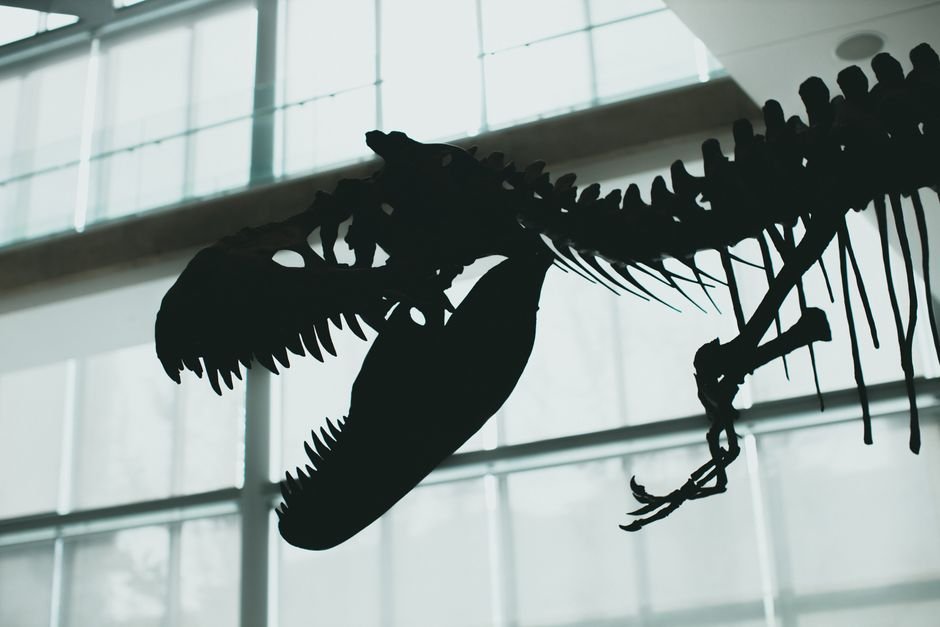
The most expensive dinosaur ever sold now has a name: Gus.
On July 14, a 67-million-year-old Tyrannosaurus rex specimen, nicknamed “Gus” after the rancher on whose land it was discovered, sold at Sotheby’s New York for $50.1 million, more than doubling the previous record of $31.8 million set by the T. rex specimen “Stan” in 2020. The winning bid was placed by phone, outlasting six other prospective buyers in a 10-minute bidding battle. The buyer’s identity has not been disclosed.
The specimen is exceptional for its completeness. Sotheby’s reported that Gus is 61% complete by bone count, 183 fossil bone elements recovered, and 75-80% complete by bone mass. The skull alone is about 82% complete, including all six dentitions. The specimen includes rare elements rarely preserved in T. rex fossils: a furcula (wishbone), a complete pelvis, both feet (only the second known T. rex with two well-represented feet), and 30 of its 32 gastralia (belly ribs).
Discovered in 2021 by Thomas Heitkamp of Theropoda Expeditions on a ranch in Harding County, South Dakota, the fossil comes from the Hell Creek Formation, the same geological formation that produced “Sue” (the Field Museum’s T. rex, sold for $8.36 million in 1997) and “Stan.” At roughly 11.6 meters (38 feet) long and 3.8 meters (12.5 feet) tall at the hip, Gus is comparable in size to Stan but with a femur measuring 128 cm (50.39 inches), larger than Stan’s.
Pathologies tell a story of violence
The skeleton bears evidence of a hard life. Bite marks from other tyrannosaurids are visible on the skull and dentary, and healed fractures in the ribs and gastralia suggest Gus survived at least one serious fight. Such pathologies are valuable to paleontologists because they record behavior, territorial combat, feeding competition, and social interaction, that is otherwise invisible in the fossil record.
Controversy follows the gavel
The record-breaking sale has reignited a long-running debate among paleontologists about the private sale of scientifically significant fossils. The Society of Vertebrate Paleontology (SVP) issued a formal statement opposing the sale, arguing that such specimens should be “preserved, documented, and accessible for future generations.” Kristi Curry Rogers, SVP President-Elect, called on the buyer to “immediately donate it to an accredited natural history museum.”
The concern is that privately owned fossils are effectively lost to science. No reputable journal will publish research based on privately held specimens because the material cannot be re-examined by other scientists, a core requirement of scientific reproducibility. Susannah Maidment of the Natural History Museum in London told the BBC: “We’re already priced out of having access to many, many specimens.” Thomas Carr of Carthage College noted that for 1/1000th of Gus’s sale price, a small institution could fund two full seasons of paleontological field work.
Sotheby’s has countered that private collections have historically formed the foundations of many great museum collections. The previous record-holder, “Apex” the Stegosaurus, which sold for approximately $44.6 million in 2024, is on long-term loan to the American Museum of Natural History, setting a potentially constructive precedent for Gus’s new owner.
What comes next
Whether Gus will ever be studied by scientists depends entirely on the anonymous buyer’s intentions. The specimen has no formal catalog number, fossil specimens destined for private sale are typically not accessioned into museum collections, and no formal scientific name has been assigned to Gus’s particular variation. If the buyer follows Apex’s example and places the specimen in a public institution on long-term loan, the scientific value of those 183 fossil elements, the bite marks, the healed fractures, the size data, could still be realized.
If not, Gus will remain what the auction records show: the most expensive dinosaur that science never got to study.
Sources
1. BBC News. (2026, July 14). Meet ‘Gus’, the world’s most expensive Tyrannosaurus rex. https://www.bbc.co.uk/news/videos/ckg8gymjv7ro
2. Sotheby’s. (2026, July 14). Natural History including Gus Rex, Lot 20. https://www.sothebys.com/
3. Helmore, E. (2026, July 14). T rex fossil ‘Gus’ sells for $50.1m at New York auction, setting new record. The Guardian.
4. Prisco, J. (2026, July 14). Rare T. rex fossil sells for record $50.1 million at auction. CNN.
5. Society of Vertebrate Paleontology. (2026). Statement on the private sale of scientifically significant vertebrate fossils.