

Beijing, May 20 — Vladimir Putin arrived in Beijing last week with a problem. Just five days earlier, Donald Trump had been sitting in the same Great Hall of the People, eating at the same table, declaring a new era of “strategic stability” with Xi Jinping. Now Putin had to pretend this did not bother him.
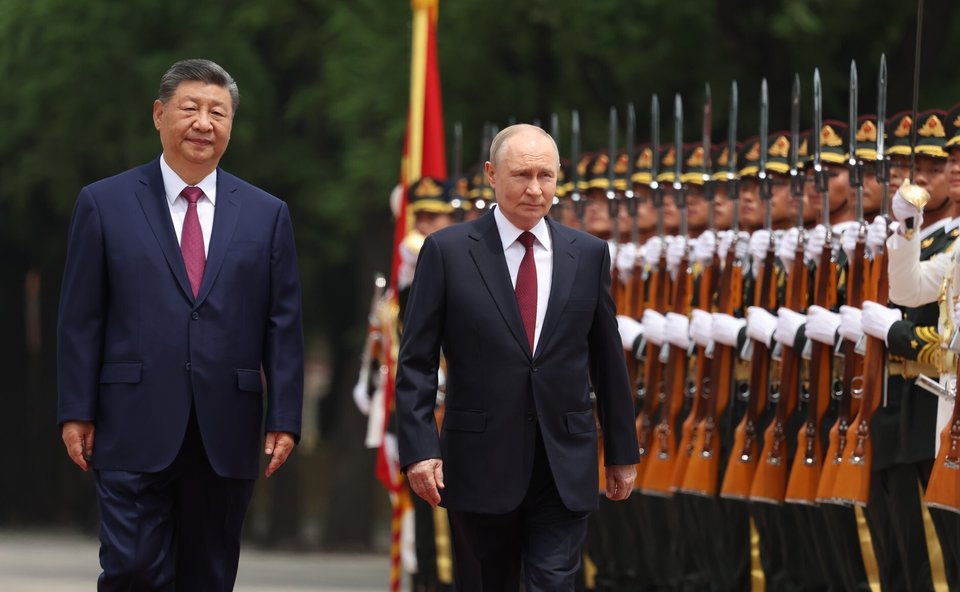
He smiled. He shook hands. He called Xi his “dear friend” and “best bosom friend.” Xi welcomed him with a red carpet and a military band. The cameras captured everything. The two leaders signed documents. They toasted. They looked like men who had the world figured out.
But the photographs lied. What happened in Beijing on May 20 was not a meeting of equals. It was the latest installment of a relationship that has become deeply one-sided — and both men know it.
What Was Signed
On paper, the summit produced a lot. The two sides signed between 22 and 40 agreements, depending on which press release you read. The main document was a “Joint Declaration” that ran for dozens of pages and covered everything from energy and finance to artificial intelligence and Arctic shipping routes. Russia’s state media called it a milestone. China’s Xinhua news agency called it a step toward “a more just and reasonable international order.”
The economic sections were the most concrete. China and Russia pledged to deepen trade settlement in their own currencies, bypassing the dollar. They agreed to expand transport corridors and coordinate the Belt and Road Initiative with Russia’s Eurasian Economic Union. They promised to boost agricultural trade, railway logistics, and energy cooperation.
On military matters, the language was vaguer but still significant. The two sides said they would deepen military trust, expand joint exercises and patrols, and strengthen coordination in bilateral and multilateral forums. But they did not create a military alliance. They did not include mutual defense commitments. China’s model of “partnership diplomacy” — a hierarchy of relationships that carry no binding security obligations — remained firmly in place.
Beijing avoided saying anything that might look like an endorsement of Russia’s war. The declaration did not mention the word “invasion.” It did not mention “aggression.” It referred to the “Ukraine crisis” — a term that transforms Russia’s assault on a sovereign state into a vague geopolitical condition.
What Was Not Signed
The most important thing that did not happen in Beijing was a deal on the Power of Siberia 2 pipeline.
Russia has wanted this pipeline for years. It would carry natural gas from Siberia to China, replacing the European markets that Moscow lost after the invasion of Ukraine. For Putin, it is not just an energy project. It is a symbol of Russia’s future — tied to China, cut off from the West.
China did not sign it. Not this time.
Negotiations have been stalled over price. China wants Gazprom to sell gas at rates close to what Russians pay domestically. Russia wants global market prices. China has all the leverage. Russia’s gas has nowhere else to go. European buyers are gone, and the pipeline infrastructure points only east. So China waits. It can afford to wait.
Chinese official accounts of the summit did not even mention Power of Siberia 2. The silence was deliberate.
This is the pattern now. Russia asks. China decides.
The Numbers Do Not Lie
The economic relationship between China and Russia looks impressive until you look closely.
Bilateral trade reached $245 billion in 2024 — double the 2020 figure. But in 2025, trade fell 6.9 percent, the first decline in five years. The structure of that trade tells the real story. Russia sells China almost nothing but fossil fuels and raw materials. China sells Russia cars, tractors, electronics, machinery, and consumer goods. It is a colonial trade pattern dressed up in diplomatic language.
Chinese investment in Russia tells an even starker story. Since 2022, Chinese companies have invested about $400 million per year in Russia. That is less than China invests in the Dominican Republic. It is less than China invests in Zambia. For a country that Russia calls its “no limits” partner, the numbers are embarrassing.
The military dimension is similarly one-sided. Before the war, Russia supplied weapons to China. Now the flow has reversed. According to Ukrainian intelligence, China supplies the majority of electronics used in Russian military drones. Russian defense industries depend on Chinese ball bearings, vehicle spare parts, optical sights, and electric detonators. Western sanctions have cleared the Russian market for Chinese goods and forced Russian raw material exporters to sell to China at Chinese prices.
Putin came to Beijing needing things. Xi came to Beijing wanting nothing in particular. That is the asymmetry in one sentence.
The Trump Factor
The timing of the summit was awkward.
Trump had just completed a three-day state visit to Beijing — the first by an American president since 2017. The two sides called it a “reset.” They agreed on “constructive strategic stability.” Trump visited Zhongnanhai, Xi’s leadership compound. He invited Xi to Washington. The photographs from that summit showed a different kind of relationship than the one Putin was hoping to project.
For Moscow, the China-U.S. reset is a geopolitical headache. Russia needs China as a counterweight to the United States. If China and the U.S. are talking, if they are managing their competition rather than escalating it, then Russia’s value to China decreases. China no longer needs Russia as a hedge against Washington in quite the same way.
Putin’s visit was partly an attempt to remind the world — and Xi — that the China-Russia relationship still matters. The joint declaration condemned “hegemonism” and “unilateral coercion.” It attacked NATO, AUKUS, and Western military blocs. These passages were aimed at Washington. But they also revealed Russia’s anxiety. Moscow needs Beijing to choose sides. Beijing prefers not to.
The West has noticed. The U.S. is now discussing what relations with “post-war Russia” might look like. This is not a casual conversation. It reflects a growing assumption in Washington and European capitals that Russia will eventually lose its war in Ukraine — and that when it does, the question of Russia’s future relationship with the world will be open. China is part of that conversation, too. Not as Russia’s ally, but as the power that will have the most influence over whatever comes next.
The Rhetoric vs. The Reality
Since February 2022, the “no limits” partnership has been tested by reality. It has not fared well.
The phrase itself — used in the joint statement after Putin’s visit to Beijing just before the invasion — suggested a relationship without constraints. But what has actually happened is the opposite. China has carefully limited its support to Russia. It has not provided lethal military aid. It has not recognized Russia’s annexation of Ukrainian territory. It has not broken with the West. It has continued to do business with Europe, the United States, and the rest of the world while also trading with Russia.
China’s position is rational. It benefits from a weakened Russia that depends on Chinese markets, Chinese technology, and Chinese goodwill. A strong Russia — one that won in Ukraine, that had options with Europe, that could negotiate from equality — would be less useful to Beijing. So China keeps Russia afloat but does not let it thrive.
The war has accelerated everything. Western sanctions forced Russia to turn east. But turning east meant accepting Chinese terms. Russia is now a junior partner in a relationship it once dominated. The Soviet Union used to be the senior partner in the socialist camp. Even in the 1990s and 2000s, Russia was the supplier of weapons and energy, China the buyer. That has reversed.
What This Means
For Ukraine, the summit was bad news. The joint declaration is not a peace document. It is a war-era manifesto that normalizes Russia as a great power partner. China’s claimed neutrality is not equidistance. A mediator whose neutrality is certified by the aggressor cannot be trusted by the victim.
For the United States, the summit was a reminder that China-Russia coordination remains durable even if it is asymmetrical. The U.S. reset with China does not mean China will abandon Russia. It means China will manage both relationships on its own terms.
For Russia, the summit was a mirror. Putin was treated with respect in Beijing. But he left without the pipeline deal, without a military alliance, and without any indication that China will do more than it is already doing. Russia needs China for survival. China needs Russia as a tool — but not enough to pay a high price for it.
The warm handshakes in Beijing concealed cold calculations. Putin and Xi will meet again. They will sign more documents. They will call each other friends. But the relationship is no longer what it was sold as. It is not a meeting of equals. It is a senior partner and a junior partner, and everyone knows which is which.
The photographs show two men smiling. What they do not show is which one is holding the leash.
Image: Vladimir Putin and Xi Jinping, Beijing, May 2026. Credit: Kremlin.ru (CC BY 4.0)
Research for this article drew on reporting from The Diplomat, War on the Rocks, Chatham House, Reuters, and the BBC.