

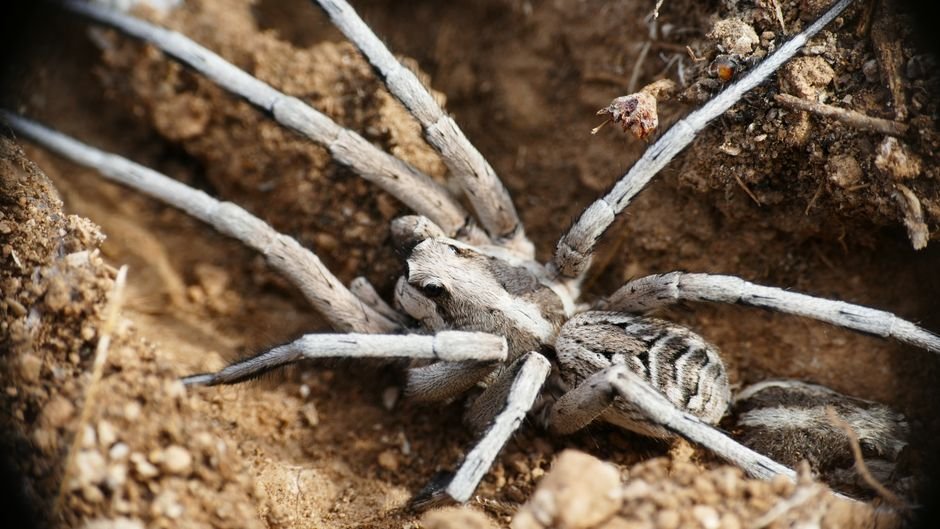
A large, hairy-legged spider that is a common, and often welcome, resident of Queensland homes has been crowned the fastest spider on the planet.
The brown huntsman (Heteropoda cervina/jugulans, the species-level taxonomy remains unresolved) was clocked at a peak speed of 3.59 meters per second (12.9 kilometers per hour, or approximately 8 miles per hour), faster than the pace of a jogging human. The measurement comes from a comprehensive study by researchers at Imperial College London and the University of Greifswald in Germany, who analyzed running speeds across 258 spider species, the largest survey of spider locomotion ever conducted.
The record was previously held by the Moroccan flic-flac spider (Cebrennus rechenbergi), which can roll downhill at speeds exceeding 1.7 m/s. But the study’s authors argue that tumbling is not running. “The flic-flac is a special type of locomotion,” said co-corresponding author Jonas Wolff of the University of Greifswald. “It is not running and it only works downhill on sand dunes.”
The brown huntsman, by contrast, covers ground the old-fashioned way: using its long legs.
Leg length is the secret
The study, posted June 15 as a preprint on bioRxiv and not yet peer-reviewed, analyzed 236 individual spiders representing 162 species directly measured by the team, supplemented with published data for an additional 96 species. The spiders ranged from the tiny money spider (Maso sundevalli, weighing approximately 1 milligram, moving at 0.018 m/s) to the massive salmon pink birdeater tarantula (approximately 52 grams, 0.4 m/s).
The key finding is that relative leg length, not body size, is the primary predictor of speed. A 30% increase in relative leg length corresponded to an approximately 30% increase in size-corrected speed. Across the full observed range of leg lengths, the fastest spiders were roughly five times faster than the slowest of the same body mass.
“Nothing could have prepared me for how it practically teleported across the arena,” said first author Shreyas Kuchibhotla, describing the tiny orange goblin spider (Oonops pulcher), which at just 0.1 milligrams still managed more than 0.2 m/s.
Ground-active hunters, spiders that actively chase prey rather than building webs or lying in ambush, were the fastest guild overall, about twice as fast as ambush predators of the same size. Phylogenetic analysis showed that approximately 82% of the variation in size-corrected speed could be explained by evolutionary ancestry, with high-speed running having evolved multiple times within the derived araneomorph lineage (the group that includes the brown huntsman and most familiar spiders).
A leap, not a sprint
Several caveats apply to the speed record. The 3.59 m/s was a peak burst lasting a fraction of a second; the average sustained speed of the brown huntsman was closer to 2 m/s. Most species in the study were represented by only a single specimen, meaning individual variation is unknown.
More importantly, the underlying paper has not yet passed peer review. As a preprint on bioRxiv, its findings should be treated as preliminary.
The speed was measured as an escape response: spiders were placed on a flat surface of grid paper and motivated to run with a gentle touch from a paintbrush. Whether similar speeds are achieved in natural terrain, leaf litter, tree bark, walls, remains to be tested.
Nevertheless, the study provides the most comprehensive picture yet of spider locomotion and reveals a simple principle: if a spider has long legs and uses them to chase prey, it is probably faster than you think. Independent expert Leanda Mason of Edith Cowan University noted that “the huntsman supplies the record-book hook, but the deeper discovery is that spider speed is shaped by leg architecture and evolutionary history, not simply by size or whether a spider spins a web.”
Disclosure: Based on a preprint (DOI below) that has not undergone peer review.
Source: Kuchibhotla, S., Kelly, M., Jackel, V. et al. “Evolutionary biomechanics of maximum running speed in spiders (Araneae).” bioRxiv (2026). DOI: 10.64898/2026.06.11.731532