

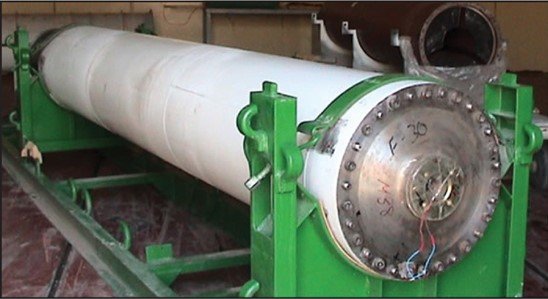
WASHINGTON — U.S. production of solid rocket motors is falling well short of what the Pentagon needs to meet its missile defense goals, according to a new report from the Center for Strategic and International Studies (CSIS) that warns of a bottleneck affecting nearly every major missile program.
The report, “Solid Rocket Motors for Missile Defense: Challenges and Opportunities for Expanding the Industrial Base,” published June 12 by CSIS fellows Wes Rumbaugh and Tom Karako, warns that the U.S. solid rocket motor (SRM) industrial base is not configured for sustained high-rate production, and that the gap between stated goals and actual output is widening.
The Pentagon’s 2027 budget request includes more than $73 billion for missile programs across mandatory and discretionary funding. That is up sharply from the prior peak of $29 billion in 2024, according to CSIS data. The military expects deliveries of more than 2,100 air and missile defense interceptors in calendar year 2027, a roughly 70% increase from approximately 1,300 in 2021. But CSIS says that pace remains well below the department’s stated production goals of roughly 5,000 interceptors per year across Army, Navy and Air Force programs.
“Achieving these goals will require dealing with myriad challenges to increasing interceptor production,” the report states.
The targets were set before Operation Epic Fury, the 2026 U.S. military campaign against Iran that burned through significant numbers of interceptors and munitions. That adds urgent replenishment pressure on top of an already strained production base.
A consolidated industry
The current constraints reflect years of consolidation that reduced the domestic SRM industry from six suppliers in 2000 to just two by 2015: Aerojet Rocketdyne (now part of L3Harris) and Orbital ATK (now part of Northrop Grumman). Solid rocket motors sit beneath nearly every major U.S. missile program, so problems in motor production, propellant ingredients, nozzles, inspection capacity, or the specialized workforce ripple across multiple weapon lines.
A new group of entrants has since moved into the market, including X-Bow Systems, Ursa Major, Firehawk Aerospace, Castelion, Anduril, Nammo, Avio USA, and Prometheus Energetics. CSIS says those companies could eventually diversify the supply base, but many have not yet shown they can move from prototypes or limited production into large production lots.
Anduril opened a high-volume SRM factory in Mississippi in August 2025, becoming the third major domestic supplier. X-Bow Systems won a $191 million foreign military sale for rocket motors in September 2025. But these remain early-stage efforts relative to the scale of demand.
Demand uncertainty and the space industry shift
The report highlights a structural change in the market. Commercial launch once helped support demand for solid rocket motors, particularly during the Space Shuttle era. But much of the commercial launch market has moved toward liquid propulsion, as exemplified by SpaceX’s reusable Falcon 9 and Falcon Heavy rockets. That shift has reduced the space sector’s role as a stabilizing source of demand for SRM suppliers, leaving missile defense programs as the primary customer facing the full brunt of boom-and-bust procurement cycles.
The report calls for stable demand signals, multiyear procurement agreements rather than year-by-year buying, direct investment in suppliers, acquisition requirements reform, and broader acceptance of new entrants.
Emergency funding alone is not enough
The Pentagon’s $1 billion direct investment in L3Harris solid rocket motor production, announced in January 2026, is a step in the right direction, the report says. L3Harris also announced a $1.27 billion expansion of its Virginia facility, doubling its footprint from 256,000 square feet (approximately 23,800 square meters). The company plans to separate its Missile Solutions business into a standalone publicly traded company via an IPO in the second half of 2026.
But CSIS warns that such direct-to-supplier intervention “cannot substitute for more proactive supply chain management by both the government and prime contractors.” These investments tend to address visible bottlenecks rather than prevent future ones, and cannot replace sustained demand from the government customer.
The report also notes that acquisition rules and cost-focused requirements make it harder to introduce new materials, components, and manufacturing processes. That limits flexibility for established suppliers while slowing the entry of newer companies.
Broader context
The report is part of a series of CSIS analyses examining the state of U.S. missile inventories and production capacity. Previous work includes “The Depleting Missile Defense Interceptor Inventory” (December 2025), “Last Rounds? Status of Key Munitions at the Iran War Ceasefire” (April 2026), and “Rebuilding U.S. Missile Inventory: A Multiyear Project” (May 2026).
The report was sponsored by Raytheon Technologies, Ursa Major, and X-Bow Systems. Its publication comes as the Department of War and Congress debate the scale and structure of long-term missile procurement in light of the Iran war’s munition consumption.
The bottom line, according to CSIS: the solid rocket motor supply base needs more than emergency cash. It needs structural reforms, sustained commitment, and a willingness to bring new suppliers online before the next crisis, not after it.
Draft for 1ban.news – Space Desk