

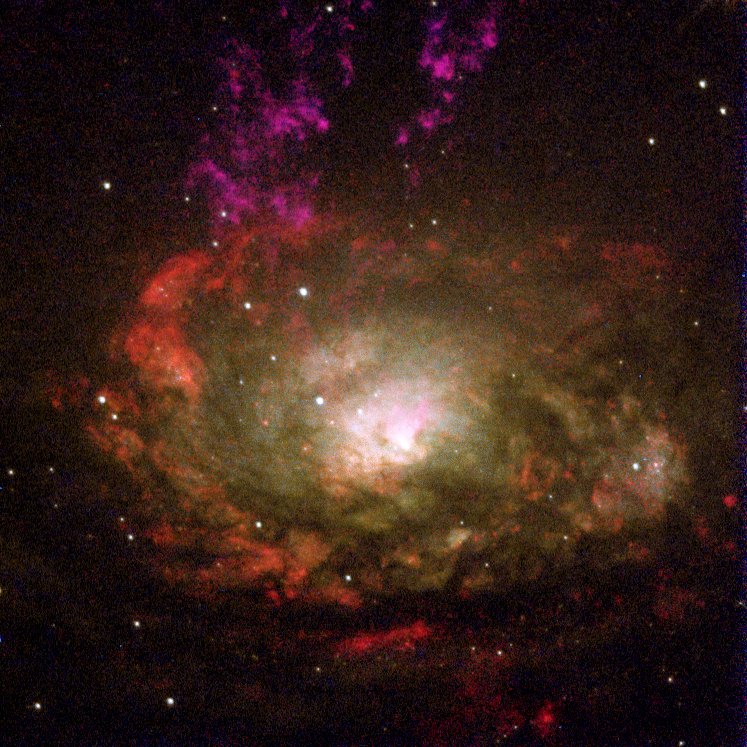
A new study has found that active galactic nuclei, the blazing hearts of galaxies powered by supermassive black holes, could be the birthplace of millions of planets — a finding that fundamentally expands our understanding of where and how planets can form in the universe.
Researchers Bhupendra Mishra from the University of Colorado Boulder and Wladimir Lyra, an astronomy professor at New Mexico State University, ran detailed computer simulations of the accretion disks that surround supermassive black holes in active galaxies. Their preprint, available on arXiv, shows that the outer regions of these disks harbor the right physical conditions for planet formation on an enormous scale.
“We were astonished,” Mishra told Space.com. “This has not been found in AGN disk context before using a streaming instability model. My colleague Wladimir Lyra, an astronomy professor at New Mexico State University, is world-renowned in the field of planet formation, and we both were totally amazed when we noticed this mass and size range of planet formation.”
How planets form in extreme environments
The key mechanism driving this process is called streaming instability, a well-studied phenomenon in conventional planet formation around stars. It describes how interactions between dust and gas in a rotating disk can spontaneously produce dense filaments of particles, which then gravitationally collapse into the seeds of planets. Mishra’s team applied this model to AGN accretion disks for the first time.
Active galactic nuclei, or AGNs, are among the most energetic objects in the known universe. They can outshine every star in their host galaxy combined. At the center of an AGN sits a supermassive black hole, with a mass ranging from millions to billions of times that of the Sun, surrounded by a vast swirling disk of gas and dust called an accretion disk. The black hole’s gravity generates intense friction within that disk, heating it to temperatures that glow across the entire electromagnetic spectrum. Some infalling matter is redirected to the black hole’s poles and fired outward as high-energy plasma jets moving near the speed of light.
It is hardly the kind of place one would expect planets to form. Yet the simulations suggest otherwise.
The outer edges of AGN accretion disks, the researchers found, have temperatures and dust concentrations that mimic conditions in protoplanetary disks around infant stars — the same kind of environment where Earth, Jupiter, and every other planet in our solar system coalesced roughly 4.6 billion years ago.
A cosmic abundance advantage
AGN accretion disks are far more gas- and dust-rich than the disks that form around a single Sun-like star. That sheer quantity of raw material means planet formation is not just possible but potentially prolific on a scale that dwarfs anything previously considered. Around a typical star, you might end up with a handful of planets. Around a supermassive black hole with an active AGN disk, the simulation suggests the count could run into the millions.
“Millions of Jupiter-mass planets were produced in the simulation at distances of tens of parsecs from the central black hole,” Mishra said — noting that one parsec is approximately 3.3 light-years (3.1 trillion kilometers). These planets form in the outer suburbs of the AGN disk, not right at the event horizon, but still in what are, by any cosmic measure, extraordinarily hostile neighborhoods.
As for what these worlds would actually be like: do not picture anything hospitable. Mishra describes them as “dust giants exceeding Jupiter’s mass” that “will look like lava balls.” These are massive, searingly hot worlds born in one of the most radiation-intense environments in the cosmos. Habitability does not enter the picture — this is planet formation as a raw physical process, stripped of any comfortable Earth-like analogies.
Migration and detection
One of the more intriguing findings from the simulations is that these planets do not stay put. The models show they will migrate radially outward over time, drifting away from the supermassive black hole and the outer edge of the AGN disk. Planetary migration is a familiar phenomenon in conventional planetary science — Jupiter is believed to have migrated inward during the early history of the solar system, a process that may have had dramatic consequences for the inner planets. The fact that it also appears to happen in AGN disks suggests the underlying physics of planet formation may be universal.
Detecting such planets is a major challenge. AGNs are distant, and the predicted planets are tiny relative to the massive structures they are embedded in. Standard exoplanet detection methods such as radial velocity measurements and transit photometry are not practical at these scales and distances.
The most promising route, according to Mishra, is gravitational lensing. When a massive foreground object sits between Earth and a more distant light source, it bends and amplifies that light in a characteristic way. A cluster of Jupiter-mass planets in an AGN disk’s outer region could produce a detectable lensing signal. The technique has already been used to discover exoplanets in the Milky Way, and NASA’s Nancy Grace Roman Space Telescope, currently under development, is expected to dramatically expand gravitational microlensing survey capabilities.
But Mishra is candid about the challenges: “Finding such an AGN is not easy unless we get lucky. I believe we could detect these planets, but we have to study this model further.”
Why this matters
This is early-stage theoretical work — a preprint that has not yet been formally peer-reviewed. But the underlying physics is credible, the streaming instability mechanism is well-established in other contexts, and the sheer scale of what the model predicts makes this a hypothesis worth taking seriously.
For decades, planet formation has been treated as something that happens in quiet, stable environments: the calm disk of gas around a young star slowly coalescing over millions of years. The discovery that planets could form around supermassive black holes in one of the universe’s most violent environments forces a fundamental rethink of how universal and how resilient the planet-building process actually is.
If streaming instability can produce millions of worlds at the edges of an AGN accretion disk, the implication is that planet formation is not a fragile, rare process requiring exactly the right conditions. It is something that the physics of dust and gravity will produce almost wherever those ingredients exist in sufficient quantities — regardless of how extreme the surrounding environment may be.
That is a significant shift in perspective, and it raises a question that astronomers will be wrestling with for years: just how many planets are out there in places we never thought to look?
Draft for 1ban.news – Space Desk