

Magnetic Monsters and Their Surroundings: New Model Explains Universe’s Brightest Supernovae
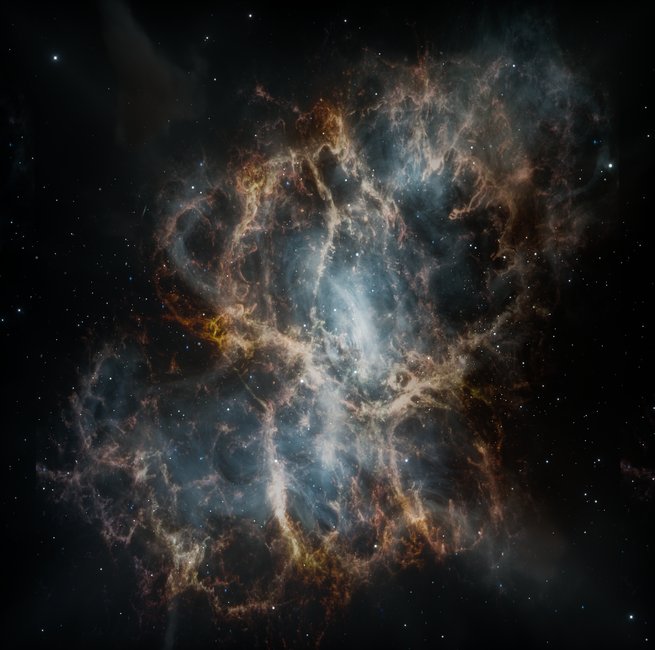
Featured image: [Artist’s impression of a magnetar inside a supernova remnant interacting with surrounding material; credit: NASA/Swift/Sonoma State University/A. Simonnet]
Superluminous supernovae (SLSNe) outshine ordinary stellar explosions by a factor of ten or more, and for years astrophysicists have debated what powers them. The leading candidates have been two distinct mechanisms: a newborn magnetar spinning at the core, or violent collisions between the expanding debris and dense gas clouds left behind by the progenitor star. A new study accepted for publication in the Astrophysical Journal argues that the real answer may be both working together.
Guang-Lei Wu, Yun-Wei Yu, and Liang-Duan Liu of the Institute of Astrophysics at Central China Normal University developed a semi-analytical hybrid model that tracks how a magnetar engine and circumstellar interaction (CSI) combine to produce the extraordinary light output of SLSNe. The paper, submitted to arXiv on July 9, 2026, shows that the two mechanisms are not competing explanations but dynamically coupled partners.
How the Hybrid Engine Works
When a massive star collapses, its core can compress into a neutron star spinning hundreds of times per second with a magnetic field a thousand trillion times stronger than Earth’s a magnetar. The newborn magnetar injects energy through a relativistic wind, inflating a hot bubble inside the expanding supernova ejecta. Part of that energy is stored as radiation; the rest accelerates the surrounding debris.
At the same time, the outermost layers of the ejecta slam into dense circumstellar material (CSM) gas and dust that the progenitor star shed in the final centuries before its death. This collision creates a circumstellar interaction region that glows brilliantly on its own.
The key insight of the new model is that the magnetar-driven shock, as it accelerates through the ejecta, can catch up with the CSI region and take over the subsequent interaction with the unshocked CSM. The two energy sources do not act independently. They merge into a single, coupled system.
What the Model Predicts
The hybrid model produces a much wider variety of light-curve shapes than either mechanism alone can explain:
Some SLSNe show luminous peaks powered primarily by the collision with CSM, followed by a steep decline. Others display a more gradual, asymmetric drop-off after peak brightness. A third group exhibits late-time emission sustained by the delayed leakage of magnetar-powered radiation that was momentarily trapped inside the ejecta.
The model also reduces the extreme parameters required by purely radioactive or purely interaction-powered interpretations. In pure magnetar models, the neutron star often needs to spin at millisecond periods and possess a magnetic field near the physical maximum. In pure interaction models, the CSM must be improbably massive. The hybrid approach spreads the energy budget across both sources, producing the same observed brightness with more physically plausible values.
“This provides a plausible way to reduce the extreme nickel-mass or initial explosion-energy requirements often encountered in purely radioactive or purely interaction-powered interpretations,” the authors write.
Context and Next Steps
The work arrives in a busy year for superluminous supernova research. In March 2026, a team led by Joseph Farah reported in Nature that the SLSN 2024afav, located over one billion light-years from Earth, showed evidence of a precessing magnetar surrounded by a tilted accretion disk. That study used periodic brightness fluctuations to infer the magnetar geometry, while the Wu et al. model addresses the broader question of how the magnetar and its environment interact dynamically.
The new model is readily testable. Next-generation wide-field surveys such as the Vera C. Rubin Observatory’s Legacy Survey of Space and Time (LSST) are expected to discover hundreds of new SLSNe annually. Each one provides a light curve that the hybrid model predicts should fall into one of several distinct morphological classes.
The paper is available as arXiv:2607.08216 in the high-energy astrophysics category and has been accepted for publication in the Astrophysical Journal.
Reviewed by Clark