

Earth Isn’t the Only Planet With Total Solar Eclipses, But It’s the Only One That Matters
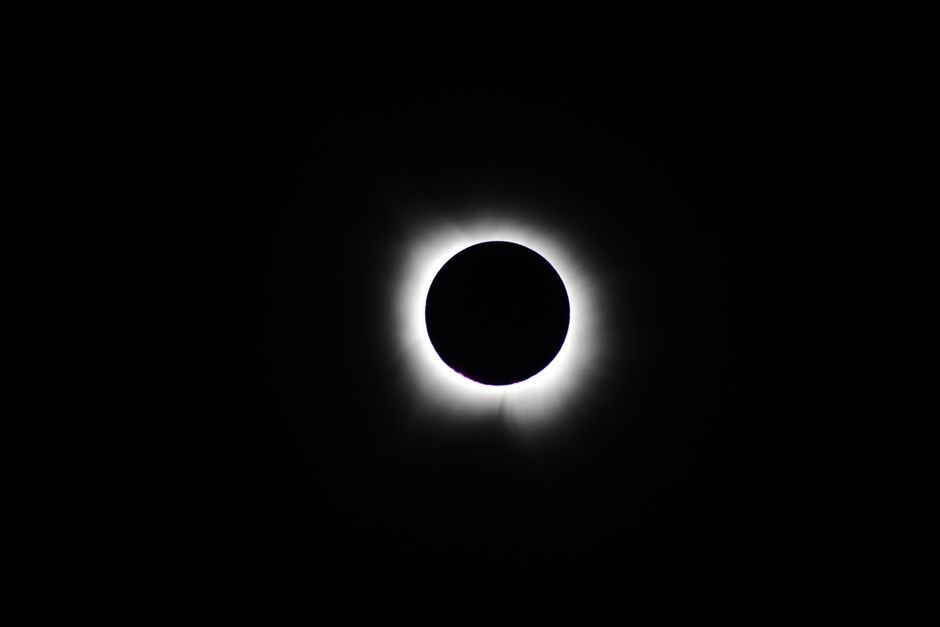
Featured image: A composite image of a total solar eclipse showing the Sun’s corona; credit: NASA/Aubrey Gemignani
There is a cosmic coincidence so precise that it borders on the miraculous: the Sun is roughly 400 times wider than the Moon, and it is also roughly 400 times farther away from Earth. These two factors cancel out perfectly, making the Moon and the Sun appear almost exactly the same size in our sky.
This alignment is why total solar eclipses exist. When the Moon slides perfectly in front of the Sun, it blocks the brilliant disk and reveals the corona, the Sun’s thin, ionized atmosphere, a sight that eclipse chasers cross continents to witness. But is Earth the only place in the solar system where this happens?
Astronomer Phil Plait, writing in Scientific American, investigated the question and found that the answer is more interesting than a simple yes or no.
The Other Planets
Mercury and Venus have no moons, so they are immediately out. Mars has two small, irregular moons, Phobos and Deimos, but neither is large enough to fully cover the Sun as seen from the Martian surface. Even though the Sun appears smaller from Mars than from Earth, Phobos the larger moon covers only part of the solar disk, producing a transit-like event rather than a true total eclipse.
Jupiter has four large moons, but they are too effective. Io, Europa, Ganymede, and Callisto all appear significantly larger than the Sun as seen from Jupiter’s cloud tops. They would block the Sun completely, but they would also block the corona, which is the whole point of a total eclipse. From Jupiter, the sky would simply go dark for a few minutes.
Saturn, however, is where the story gets interesting.
The Epimetheus Exception
Saturn’s moon Epimetheus is tiny: roughly 130 kilometers (80 miles) across at its widest, with an irregular potato-like shape. It orbits Saturn at about 151,450 kilometers. From Saturn’s surface, looking up from the equator, Epimetheus appears slightly larger than the Sun. But from Saturn’s horizon, where the moon is farther away by roughly the planet’s radius of 60,000 kilometers, it appears slightly smaller.
At some point between zenith and horizon, Epimetheus and the Sun appear exactly the same size. This creates the geometric conditions for a true total solar eclipse on Saturn. There are, however, several catches.
The Sun from Saturn appears only about one-tenth the size it does from Earth, so the eclipse would be visible only through a telescope. The eclipse itself would last less than 10 seconds. And it can only happen at Saturn’s equinoxes, which occur twice every 29.5 Earth years.
Uranus may offer a similar spectacle with its moon Perdita, roughly 30 kilometers wide, though its diameter is not precisely known. If it does work, the eclipse would last a few seconds and occur only once every 42 years.
Earth Still Wins
Technically, then, Earth is not unique in hosting total solar eclipses. But the comparison reveals why Earth’s eclipses are special. They last several minutes, not seconds. They are frequent, occurring somewhere on the planet roughly every 18 months. They reveal the corona in spectacular detail without a telescope. And they happen under a sky where the Sun and Moon appear equally matched.
The next total solar eclipse is August 12, 2026, with a path of totality crossing Greenland, Iceland, and Spain. For anyone who has never seen one, the corona is worth the trip.