

Published: June 04, 2026, 02:44 UTC
Neutral-Atom Quantum Computers Just Crossed a Critical Threshold
In the race to build a useful quantum computer, three fundamentally different technologies have emerged as frontrunners. Superconducting circuits — the approach used by Google and IBM — operate at millikelvin temperatures inside massive dilution refrigerators. Trapped ions — the approach favored by Quantinuum and IonQ — use lasers to suspend individual charged atoms in electromagnetic cages. And then there are neutral atoms: uncharged atoms held in focused laser beams called optical tweezers, operating at room temperature and capable of reconfiguring their connections on the fly.
On June 3, 2026, Atom Computing — a startup based in Berkeley, California — announced that its neutral-atom processor has crossed a milestone that brings the technology firmly into contention. The company demonstrated sustained quantum error correction using a toric code on a neutral-atom platform for the first time, producing a logical qubit whose error rate is measurably lower than the physical qubits from which it is built.
This is the threshold that matters. A quantum computer without error correction is fundamentally unreliable — quantum states are exquisitely fragile, and even a single stray photon can corrupt a calculation. The industry has known for decades that quantum error correction (QEC) is the only path to useful computation. The question has always been whether any given platform can actually implement it at scale.
Neutral atoms just gave their answer.
How the Toric Code Works
The toric code is a well-understood quantum error-correcting code that arranges data qubits and measurement (ancilla) qubits in a checkerboard pattern. The ancilla qubits are repeatedly measured — in what’s called a syndrome extraction cycle — to detect errors in the data qubits without disturbing the quantum information they hold. If the code detects that a data qubit has flipped, it can apply a correction. If the code itself introduces more errors than it fixes, you’re below threshold — and your quantum computer is getting worse, not better, the more qubits you add.
Atom Computing’s experiment used two code sizes: a distance-8 code (16 data qubits and 16 ancilla qubits) and a distance-16 code (32 data qubits and 32 ancilla qubits). The larger code is expected to perform better if the system is operating below the error-correction threshold — and that’s exactly what the company observed. The logical error rate dropped as the code size increased, confirming that the neutral-atom platform is operating in the sub-threshold regime where adding more qubits actually reduces errors.
This is the same kind of scaling demonstration that Google achieved with its Willow superconducting processor in December 2024, and that Quantinuum has shown with trapped ions. Neutral atoms have now joined the club.
The Numbers
The results, announced in a company technical report, show a per-cycle logical error rate for Z-type errors (bit-flip errors) of approximately 0.56–0.74% for the distance-16 code. These are the errors the toric code is best at catching, and the rate is encouragingly low.
The picture for X-type errors (phase-flip errors) is less clean: approximately 3.0–3.4% per cycle. This asymmetry reflects the underlying physics of neutral-atom quantum gates. The Rydberg interaction — which enables entanglement between atoms — is more susceptible to certain error mechanisms than the single-qubit operations. The company explicitly notes that improving the Rydberg gate fidelity is a priority for future work.
The experiment ran for up to 90 syndrome extraction cycles — a measure of sustained operation. After approximately 10 cycles, the error suppression plateaued, a signature of correlated errors that the team attributes to imperfections in the mid-circuit atom replacement process.
The Architecture Behind the Result
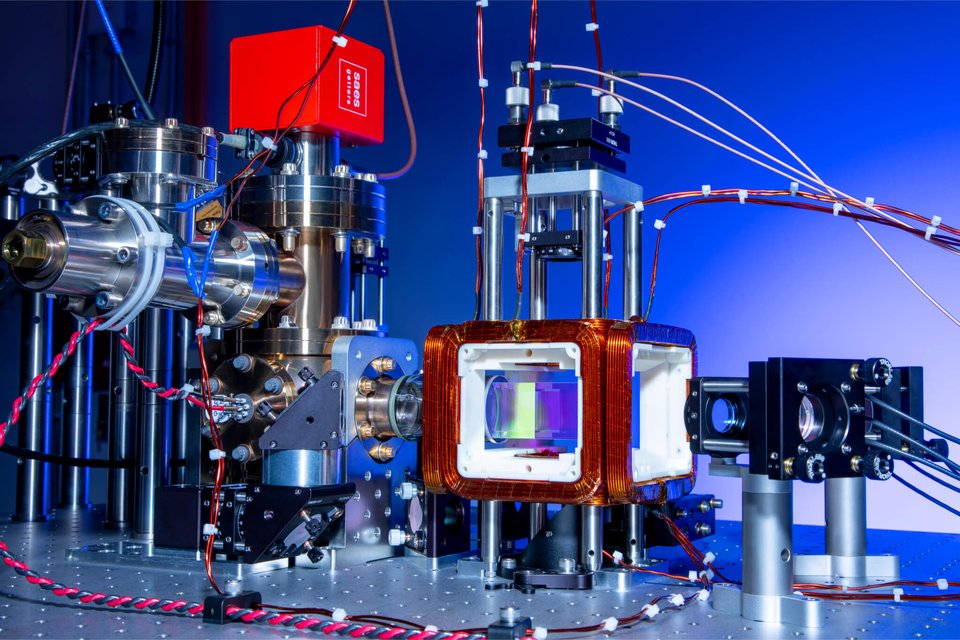
What makes neutral atoms distinctive is not just that they work — it’s how they work. Atom Computing’s processor uses ytterbium-171 atoms, whose nuclear spins serve as the qubits. These atoms are loaded into optical tweezers — highly focused laser beams that trap individual atoms at their waist — and arranged in a two-dimensional grid.
The processor uses a zone-based architecture with three regions: an entangling zone where quantum gates are performed, a storage zone where idle atoms wait, and a loading zone where fresh atoms are prepared. Atoms are shuttled between zones using movable optical tweezers, a technique unique to neutral-atom platforms. This dynamic connectivity means that any qubit can be moved next to any other qubit — effectively providing all-to-all connectivity without the engineering nightmare of wiring up every pair of qubits.
Because the qubits are neutral atoms held by light, the system can also replace atoms mid-circuit. When a qubit is measured and collapses, a fresh atom from the storage zone can be moved into its place. The storage zone itself is refilled from a magneto-optical trap (MOT) every 10 cycles, ensuring a continuous supply of fresh qubits. This mid-circuit atom replacement is a capability that superconducting and trapped-ion systems cannot match — in those modalities, dead qubits stay dead.
The tradeoff is fidelity. The atom reloading process introduces approximately 1.6% contrast loss per refill — a modest degradation that accumulates over many cycles. And the two-qubit gate fidelity, at roughly 99.4–99.6%, is significantly lower than the 99.99% fidelity that trapped-ion systems routinely achieve.
The Broader Context
Atom Computing is not alone in the neutral-atom race. The field is moving remarkably fast.
In November 2025, a team from Harvard, QuEra Computing, and MIT published results in Nature showing 448 physical qubits arranged into 48 logical qubits — the largest number of logical qubits ever demonstrated. In April 2026, QuEra published simulations showing that a quantum low-density parity-check (qLDPC) code could enable 1,156 logical qubits from 2,312 physical qubits — a 2:1 physical-to-logical ratio that would be dramatically more efficient than the surface code. (The caveat: these are simulations, not hardware results.)
Pasqal, the French neutral-atom competitor, announced in May 2026 that it had achieved 99.4% gate fidelity across 1,024-atom registers and demonstrated a logical qubit operating on a real application. Caltech researchers published the largest neutral-atom array ever assembled — a staggering 6,100 qubits — though at lower fidelity than commercial systems.
And Atom Computing itself already sells the AC1000, a commercial system with more than 1,200 physical qubits, single-qubit gate fidelities above 99.9%, and two-qubit gate fidelities above 99.6%. The hardware exists, it’s commercially available, and it’s improving every quarter.
How Neutral Atoms Compare
The three-way race breaks down roughly like this:
Superconducting qubits (Google, IBM) have the highest two-qubit gate fidelities and the most mature ecosystem, but they require millikelvin temperatures, their connectivity is fixed by physical wiring, and scaling to 10,000+ qubits faces significant engineering challenges in cryogenic wiring and heat management.
Trapped ions (Quantinuum, IonQ) have the highest gate fidelities in the industry — up to 99.99% for two-qubit gates — and all-to-all connectivity via shuttling. But ion shuttling is slow compared to neutral-atom transport, and the systems operate at ultra-high vacuum with complex laser control.
Neutral atoms (Atom Computing, QuEra, Pasqal) offer room-temperature operation, the fastest scaling trajectory (1,200+ qubits commercially, with a plausible path to 10,000+), and unique capabilities like dynamic reconfigurability and mid-circuit qubit replacement. The tradeoff is lower two-qubit gate fidelity — the difference between 99.6% and 99.99% is not a detail; it’s more than two orders of magnitude in error rate.
Each platform has a path to useful quantum computing. None has all the pieces: high qubit counts, low error rates, universal gate sets, and sustained error correction all in one system. The winner — if there is a single winner — will be determined by which platform crosses the finish line first.
The Distance Still to Travel
For all the excitement, it is worth being precise about what these results mean — and what they don’t.
A logical error rate of 0.6% per cycle is dramatically better than the ~1–3% physical error rates of the individual qubits. It is proof that error correction is working. But practical quantum algorithms — Shor’s algorithm for factoring large numbers, or quantum simulation of molecules — require logical error rates on the order of 10⁻⁶ or lower. That is roughly five orders of magnitude better than what Atom Computing has demonstrated.
Getting there will require larger codes, better physical gates, and a deeper understanding of the correlated errors that currently cause error suppression to plateau. The fact that error suppression stalls after roughly 10 cycles is a real limitation — it means the code is not correcting independently as theory predicts.
The X-error asymmetry also needs attention. A logical qubit with 3% phase-flip error per cycle is not useful for much, and the toric code’s ability to handle asymmetric errors depends on the specifics of the implementation.
And while Atom Computing’s result is the first sustained QEC on a neutral-atom platform, it is not the first QEC result overall. Google’s Willow processor demonstrated below-threshold surface code operation in December 2024. Quantinuum has shown sustained QEC on trapped ions. Neutral atoms are now in the same conversation — but they are not yet ahead.
What Comes Next
The neutral-atom community is converging on a set of known priorities: improving Rydberg gate fidelity, reducing the error overhead from mid-circuit atom replacement, and scaling the toric code demonstration to larger distances where the error suppression is more dramatic.
Atom Computing’s result is significant not because it solves quantum error correction — no single result has — but because it eliminates a meaningful doubt. There was a real question about whether neutral atoms could sustain error correction over many cycles in a practical architecture. The answer is now clear.
The three-way race for useful quantum computing now has three genuine contenders. Neutral atoms have arrived.
Sources: New Scientist, “Neutral-atom quantum computer works out its errors,” June 3, 2026. Atom Computing, “Sustained Quantum Error Correction on a Neutral-Atom Processor,” June 3, 2026. QuEra Computing, qLDPC simulation results, April 2026. Pasqal, “High-fidelity quantum operations in 1,024-atom registers,” May 2026. Harvard/MIT/QuEra, Nature 2025. Google Quantum AI, “Quantum error correction below the surface code threshold,” Nature, December 2024. Caltech, 6,100-qubit neutral-atom array, 2026.